Average Salary in Zürich? The Median by Industry, 2024

The short answer
If you work in the city of Zürich, the median salary is CHF 8,508 gross a month for a full-time job of 40 hours a week. Across the canton it's CHF 7,502, and across Switzerland CHF 7,024. These figures come from the federal Swiss Earnings Structure Survey 2024, the latest official figures. Median means half of all employees earn more and half earn less.
Those numbers hide big differences. In the canton, the median in restaurants and catering is CHF 4,859, in IT services CHF 11,110. We show what the figures actually measure, how far pay spreads within one industry, and how to compare your own offer with them. All values come from the Federal Statistical Office (FSO, called BFS in German), the canton's statistical office and the city's own statistics office, Statistik Stadt Zürich. Most of their pages are in German.
How much do you earn in Zürich?
There are three official figures, and the one that fits you depends on where you work. The best known, CHF 7,024, is the median for all of Switzerland, which the FSO published in November 2025. If you see CHF 6,788 elsewhere, that's the previous survey, for 2022.
The figures come from the Swiss Earnings Structure Survey, in German the Lohnstrukturerhebung (LSE). Every two years the FSO asks employers for their wage data; for 2024 that was some 34,000 companies with 2.9 million employees. Besides Switzerland as a whole, it reports seven major regions. The Zürich region is simply the canton of Zürich, and its median is CHF 7,502, as the FSO's data table shows. That's the highest of all regions. Ticino is the lowest, at CHF 5,708.
Why Zürich comes out so far ahead is something the canton's statistical office looked into in June 2026. In all the other cantons taken together, the median is about CHF 600, or 9%, lower. The office puts about 45% of that gap down to structure: Zürich has more jobs in banking, IT and consulting, more large companies, and less manufacturing and construction. The model can't explain the other 55%. It could be regional factors nobody measures, or simply that Zürich employers pay more for comparable work. In the low and middle pay range, the analysis points to the second.
For the city, Statistik Stadt Zürich runs its own analysis of the same survey. It counts everyone who works at a workplace inside the city, wherever they live. Its median in 2024 was CHF 8,508.
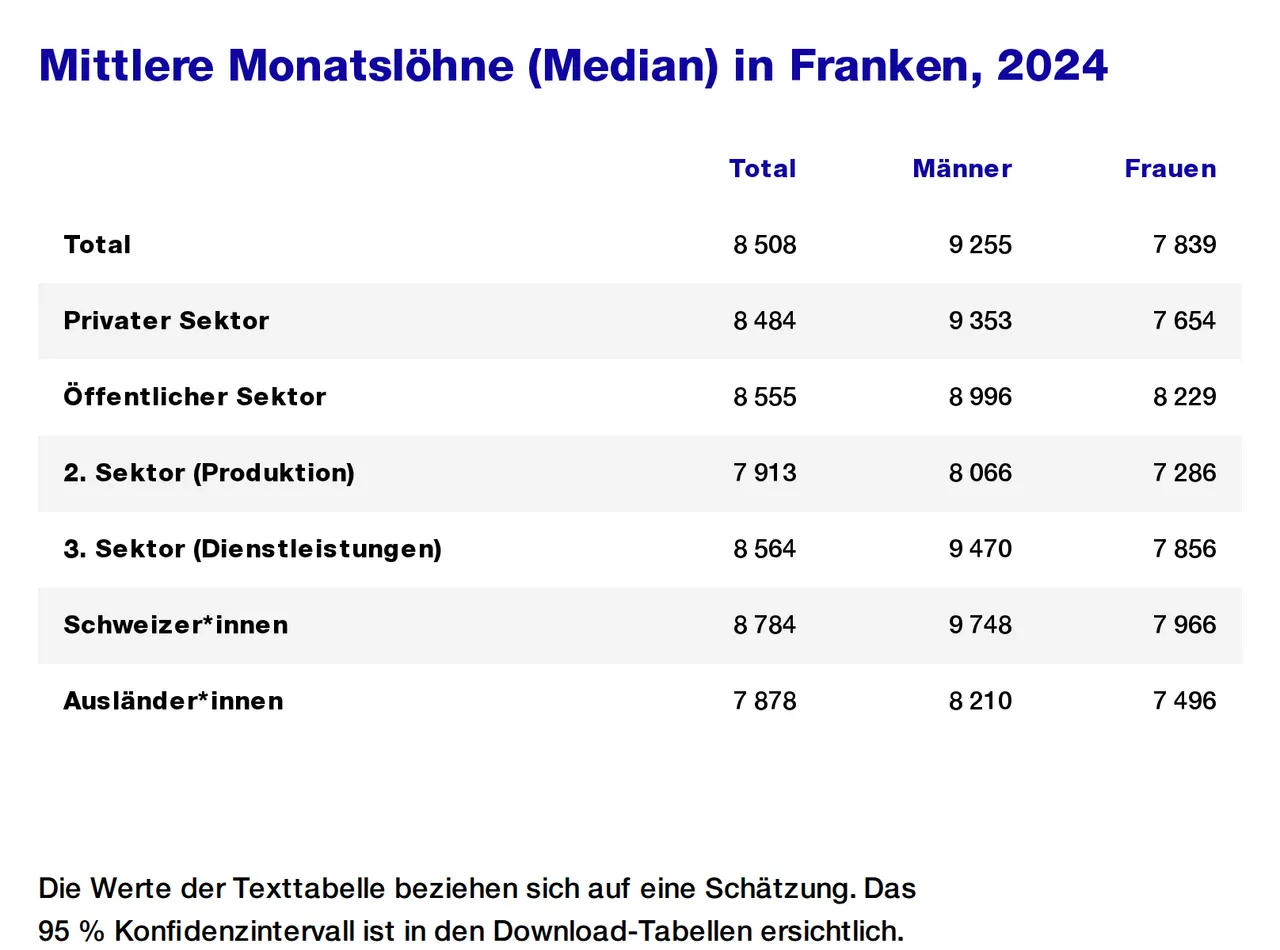
So if you're looking for a job in the city, CHF 8,508 is the figure to compare with; for Winterthur or Uster, the canton's figure fits better. Before you do any maths with it, though, it pays to look at what the word median hides.
Median or average: what the figure measures
The median is the salary in the middle. Line up every full-time salary from lowest to highest, and half earn more than the median while half earn less. The average, or mean, is something else: all salaries added up and divided by the number of employees. The FSO says plainly in its release that the two shouldn't be confused. Even so, some pages promise you the "average salary" and then quote a median.
In Zürich the difference matters, because salaries spread a long way at the top. In the canton, the bottom 10% earn less than CHF 4,761 and the top 10% more than CHF 13,970. From the median down to the lower line is CHF 2,741; up to the upper line it's CHF 6,468. Very high salaries pull an average up but barely move the median. That's why the median gives a better picture of what a typical person earns.
On top of that, the figure is "standardised". The FSO takes the salary paid in October 2024 and converts it to 40 hours a week and 4⅓ weeks a month. It includes:
- employees' contributions to social insurance (so the salary is gross)
- one twelfth of the 13th month salary, the extra month's pay many Swiss employers add each year
- one twelfth of the yearly bonus
- extra pay for shift, night and Sunday work
Family and child allowances are not included. According to the FSO's methodological notes, which come with the full release in German, the survey covers employees in industry and services, in both the private and the public sector. Farming and the self-employed aren't counted. So the figure isn't the amount on your payslip. It's built for comparing jobs with each other, and the first thing a comparison shows is the industry.
Salaries in Zürich by industry
Pay varies enormously between industries. In the canton, the median ranges from CHF 4,859 in restaurants and catering to CHF 11,754 at head offices and in management consulting. The city's figures show the same pattern: finance and insurance services reach CHF 11,601 there, information and communication CHF 10,905, hospitality CHF 4,929.
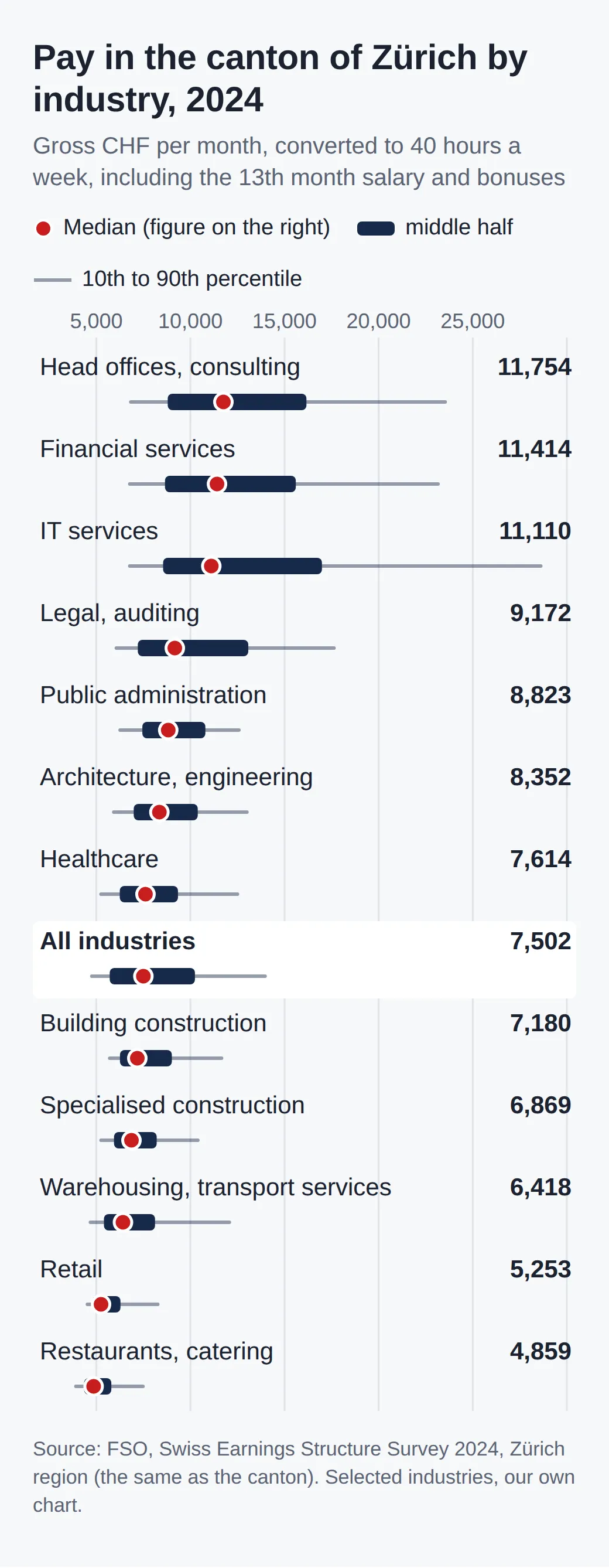
For a salary negotiation, the dark bar matters almost more than the dot. It shows the middle half: a quarter of employees earn less than its left end, a quarter more than its right end. Where you land inside it depends on your experience, your role and the company. The canton's statistical office shows the same values for the broad sectors of the economy on its page on structure and pay.
IT and software
In IT services, the median in the canton is CHF 11,110, with the middle half between CHF 8,551 and CHF 16,988. No industry in our chart spreads as widely: the top 10% earn more than CHF 28,614 a month. Split by occupation, the FSO table by occupational group shows the gap between building software and running systems. Information and communications technology professionals, a group that includes software developers, have a median of CHF 10,732. ICT technicians, for example in support or operations, have CHF 8,282. In the first group, people under 30 are at CHF 7,791. You'll find open roles on the operations side under IT operations.
Finance and insurance
In financial services the median is CHF 11,414 (middle half CHF 8,651 to CHF 15,599); in insurance it's CHF 9,658. Bonuses play a big part here. Across Switzerland, senior management at banks got an average bonus of CHF 147,796 in 2024, while employees without a management role, across all industries, got CHF 4,601. Because the survey adds one twelfth of the bonus to the monthly figure, it's already part of these medians.
Healthcare
In healthcare the median is CHF 7,614, just above the figure for all industries. The middle half runs from CHF 6,248 to CHF 9,339. In care homes it's CHF 6,388, in other social work CHF 6,866. By occupation, health professionals have a median of CHF 8,545, while health assistants and technicians have CHF 6,451. Pay here has barely moved since the survey: according to the FSO's wage index, wages in health and social work rose by only 0.4% across Switzerland in 2025.
Construction and trades
In building construction the median is CHF 7,180, in specialised construction such as fit-out and finishing work CHF 6,869. By occupation, building and finishing trades workers earn CHF 6,444, electricians and electronics workers CHF 6,459. The bottom end stands out: in building construction, only one employee in ten earns less than CHF 5,713. Across all industries that line is CHF 4,761. The top stays lower, though: the top 10% in building construction earn more than CHF 11,654, in financial services more than CHF 23,157.
Hospitality and retail
In restaurants and catering the median is CHF 4,859, with the middle half between CHF 4,352 and CHF 5,799. In hotels it's CHF 4,948, in retail CHF 5,253. Across Switzerland, almost half of all jobs in restaurants and catering count as low-paid, meaning under CHF 4,683 for a full-time job. For the city of Zürich, the Federal Supreme Court upheld the city minimum wage of CHF 23.90 an hour in May 2026. It doesn't apply yet, though, because there's no start date.
Within each industry, your salary then depends heavily on two things you bring with you.
How much age and education matter
Pay rises with age, and the big jump comes after 30. In the canton, the median for employees up to 29 is CHF 5,750, for those aged 30 to 49 it's CHF 7,907, and from 50 it's CHF 8,362. Starting your career in Zürich often means a salary well below the headline figures.
Education has an even bigger effect. Statistik Stadt Zürich reports these medians for 2024 by highest qualification:
| Highest qualification | Median, city of Zürich 2024 |
|---|---|
| University, ETH | CHF 11,201 |
| University of applied sciences, teacher training college | CHF 10,181 |
| Higher vocational education | CHF 9,218 |
| Matura (school-leaving exam), teaching diploma | CHF 7,457 |
| Apprenticeship | CHF 7,006 |
| No completed vocational training | CHF 5,324 |
The third row is worth a second look. Higher vocational education is the Swiss route after an apprenticeship, such as a federal professional exam or a college of higher education. People who complete it earn a median of around CHF 1,760 more than those with only the Matura. One gap remains even with the same qualification, though: the one between women and men.
The gender pay gap in Zürich
In the canton of Zürich, the median salary for women is CHF 6,968 and for men CHF 7,936. That's 12.2% less, by our own calculation, using the same method that gives the FSO its 8.4% for Switzerland as a whole. In the city the gap is wider still: CHF 7,839 against CHF 9,255, or 15.3%.
The gap is largest in the well-paid industries. In financial services in the canton, women's median is CHF 9,929 and men's CHF 12,563, so women there earn about 21% less. In IT services it's CHF 9,808 against CHF 11,489. That fits an FSO finding for Switzerland as a whole: in jobs with high responsibility, women were 14.0% behind in 2024; in jobs without a management role, 5.2%.
Part of these differences can be explained by age, education, role and industry, the FSO writes, and part cannot. For your own negotiation, that means comparing your offer with the figure for all employees in the industry, not just the figure for women. Otherwise you carry the gap into your own ask. How much of your gross salary actually reaches your account is the next question.
Gross, net and the 13th month salary
Every figure in this article is gross. A few fixed contributions come off a gross salary first. According to the federal overview of social insurance for 2026, that's 5.3% for AHV, IV and EO (old-age and survivors' insurance, disability insurance and income compensation) and 1.1% for unemployment insurance (ALV), the latter up to an annual salary of CHF 148,200. On CHF 7,000 gross, that's CHF 448 a month in total.
Two more deductions differ from one employer to the next. Your contribution to the Pensionskasse, the workplace pension fund, depends on the fund and on your age. The law sets retirement credits from 7% (age 25 to 34) up to 18% (55 and over) on the so-called coordinated salary, the part of your annual salary between CHF 26,460 and CHF 90,720. The employer must pay at least half. Insurance against accidents outside work is usually paid by employees themselves, and each insurer sets its own premium.
Your employer deducts tax directly for only some employees. If you live in the canton of Zürich, don't have a C permit (permanent residence) and aren't married to a Swiss national or a C permit holder, you pay Quellensteuer, a withholding tax taken straight from your salary. If you earn CHF 120,000 gross a year or more, you also file a tax return afterwards. Everyone else pays their taxes themselves later. Health insurance is normally something you pay yourself too; it isn't deducted from your salary.
With the 13th month salary the maths is simple; you just have to do it. In 2024, 75.9% of employees across Switzerland got one. Because the survey adds one twelfth of it to the monthly salary, an offer of CHF 6,500 times 13 is worth as much as CHF 7,042 times 12. In Zürich, what's left after deductions mostly has to cover one thing: the rent.
What a salary is worth in the city
How well a salary in the city covers the rent depends a lot on the industry. According to the city's rent survey, the typical rent for a 3-room flat was CHF 1,578 a month in March 2024, not counting service charges (Nebenkosten). With non-profit landlords such as housing cooperatives it was CHF 1,022, with all other landlords CHF 1,875. Rents have risen by 6 to 9% since 2022.
Compare the CHF 1,875 with salaries and the gap between industries becomes concrete. On the city median of CHF 8,508, that rent is about 22% of gross pay. On the hospitality median of CHF 4,929, it's 38%, before service charges, deductions and health insurance. The same "Zürich salary" means very different things in daily life. All the more reason to check a specific offer carefully.
How to check a job offer
To compare an offer with the statistics, you need to put it on the same basis. That takes three steps: work out the annual salary, divide by 12, and convert to 40 hours. The last step is often forgotten: if the contract says 42 hours a week, the same monthly salary is worth less per hour than at 40.
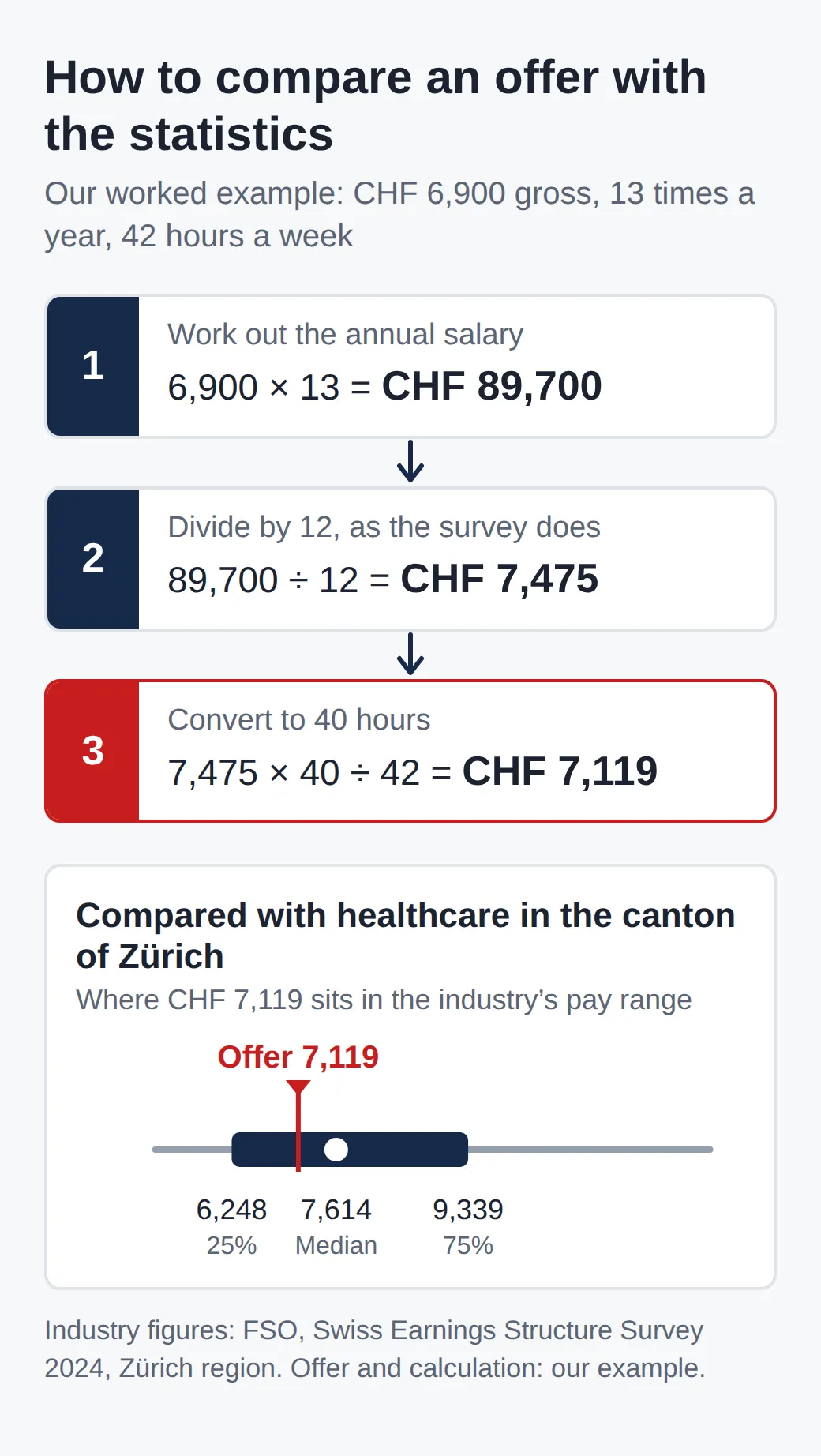
In the example, the offer sits inside the middle half but below the industry median. Whether that's fair depends on your profile. For someone under 30, it's well above the median for that age group across all industries, CHF 5,750. With long experience you can expect more: from 50, that median is CHF 8,362. Don't forget a bonus either. If it's guaranteed, one twelfth of it belongs in step 2.
If you negotiate, name your source and show your maths. It comes across as more factual than a gut feeling. You could put it like this:
According to the Swiss Earnings Structure Survey 2024, the median salary in healthcare in the canton of Zürich is CHF 7,614 for a 40-hour week, and your offer works out at CHF 7,119 on the same basis. With my experience, I'd expect to be at least at the median, so I'd like to propose CHF 7,400 paid 13 times a year.
One more calculation is needed if the job isn't full-time.
Part-time: the statistics scale up
The survey scales every part-time salary up to a full-time job so that jobs can be compared. A job at 80% paying CHF 5,600 therefore counts as CHF 7,000 at 100%. To compare your pay with the figures in this article, divide your salary by your work percentage (0.8 for an 80% job) before you do the three steps above. What reaches your account at the end of the month is, of course, still the part-time amount.
What comes next
The 2024 figures are the latest there are. The next survey, covering salaries in 2026, starts in January 2027, according to the FSO. The first results of the last round came out a little over 13 months after the reference month of October, so new figures are unlikely before late 2027. Until then, the values above will help you judge an offer: convert it, find your industry and your age group, and see whether it sits nearer the left or the right end of the dark bar. You'll find matching open jobs on our site by field, for example in healthcare, finance and accounting or trades and construction.
Common questions
- Is there a minimum wage in Zürich?
- Not yet. City voters approved a minimum wage of CHF 23.90 gross an hour in June 2023, and the Federal Supreme Court upheld the rules on 12 May 2026. It is still open when it will take effect. The city says it will announce the date at least six months ahead, and until then your contract and any collective labour agreement apply.
- Have salaries in Zürich gone up since 2024?
- Across Switzerland, nominal wages rose by 1.8% in 2025, with inflation at 0.2%. The gap between industries was wide: 3.3% in public administration, only 0.4% in health and social work. There is no separate figure for Zürich, so the 2024 values are probably a little too low today.
- Do foreigners and expats earn less in Zürich?
- At the median, yes. In the city of Zürich the median salary in 2024 was CHF 8,784 for Swiss nationals and CHF 7,878 for foreign nationals. Across Switzerland it depends a lot on the job: without a management role, people on a B permit earn less than Swiss nationals, while in jobs with high responsibility they earn more.
- Are bonuses included in Swiss salary statistics?
- Yes. The official survey adds one twelfth of the yearly bonus to the monthly salary. Across Switzerland, just under a third of employees got a bonus in 2024, averaging CHF 11,967 a year. So when an offer includes a bonus, compare the full annual amount, not just the base salary.