Zurich Job Market 2026: Unemployment, Jobs, Skills Shortage

Autumn 2026 at a glance
Zurich's job market in autumn 2026 is softer than it was three years ago, but it isn't weak. At the end of September, 25,695 people in the canton were registered as unemployed, a rate of 2.9 percent, just below the 3.0 percent for Switzerland as a whole. At the same time, more people work in the canton than a year ago, and employers are looking for more staff. The catch: people who lose their job take longer to find a new one.
Behind the average, two trends pull in opposite directions. Unemployment has risen sharply within a year in IT and office jobs and in banking, while it has fallen in construction. We put the figures from the State Secretariat for Economic Affairs (SECO), Zurich's Office for Labour and the Federal Statistical Office (FSO) into context: what they measure, what they leave out and what matters for your job search. These are the latest figures available in October 2026.
How high is unemployment in Zurich?
The unemployment rate in the canton of Zurich is 2.9 percent as of the end of September 2026. The Office for Labour (page in German) counts 25,695 unemployed people, 355 fewer than in August. The seasonally adjusted figure, which strips out the swings that come back every year, also fell slightly, by 171 people. That is the first drop in quite a while.
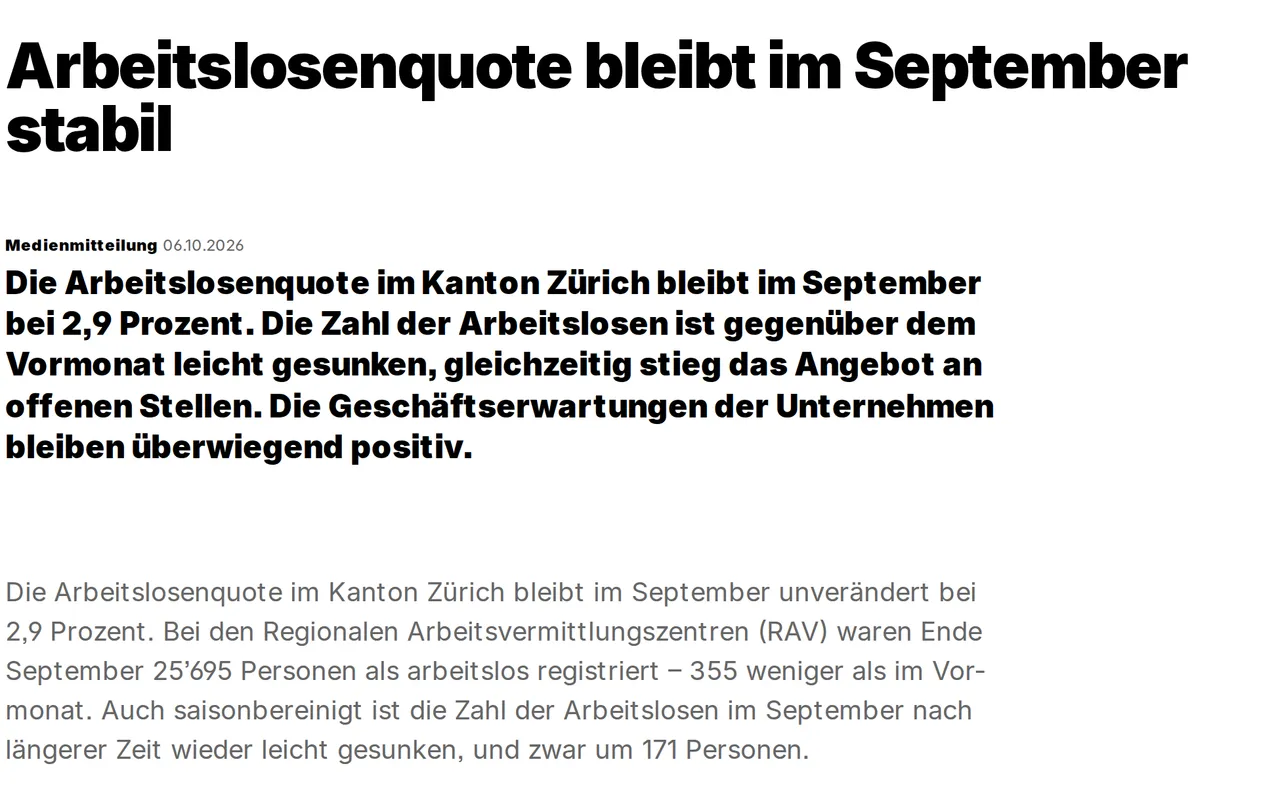
A year earlier, the rate was 2.6 percent. In September 2023 it was 1.8 percent, with 15,132 people out of work. So in three years the number has risen by about 70 percent. That sounds like a crisis, but it is mostly a return to normal. 2023 was an exceptional year: the rate averaged just over 1.7 percent, and in its review of 2023 the canton described a noticeable shortage of workers. For 2025, the Office for Labour reported an average of 2.6 percent against a long-term average of around 3 percent. Today Zurich sits roughly where it has sat for many years.
One caveat when comparing with earlier years: since 2023, SECO divides the number of unemployed by a larger workforce than before, about 4.72 million people nationwide instead of 4.60 million. That makes the rates come out slightly lower than under the old calculation. More important than this detail, though, is who gets counted in the rate at all.
Unemployed or jobseeker: what the figures count
You only count as unemployed if you are registered with a regional employment centre (RAV), have no job and could start straight away. Whether you receive unemployment benefits makes no difference. That is how the definitions in SECO's September 2026 report (in German) put it. If you don't register with the RAV, you are missing from these statistics entirely.
The broader figure is jobseekers, meaning everyone registered with the RAV. In the canton there were 40,581 at the end of September, a rate of 4.5 percent (Switzerland: 4.8 percent). Among them are 8,080 people who have a full-time or part-time job and are looking for another one. A further 4,100 have interim earnings, the official term for pay from a job someone takes while staying registered with the RAV and carrying on with the search.
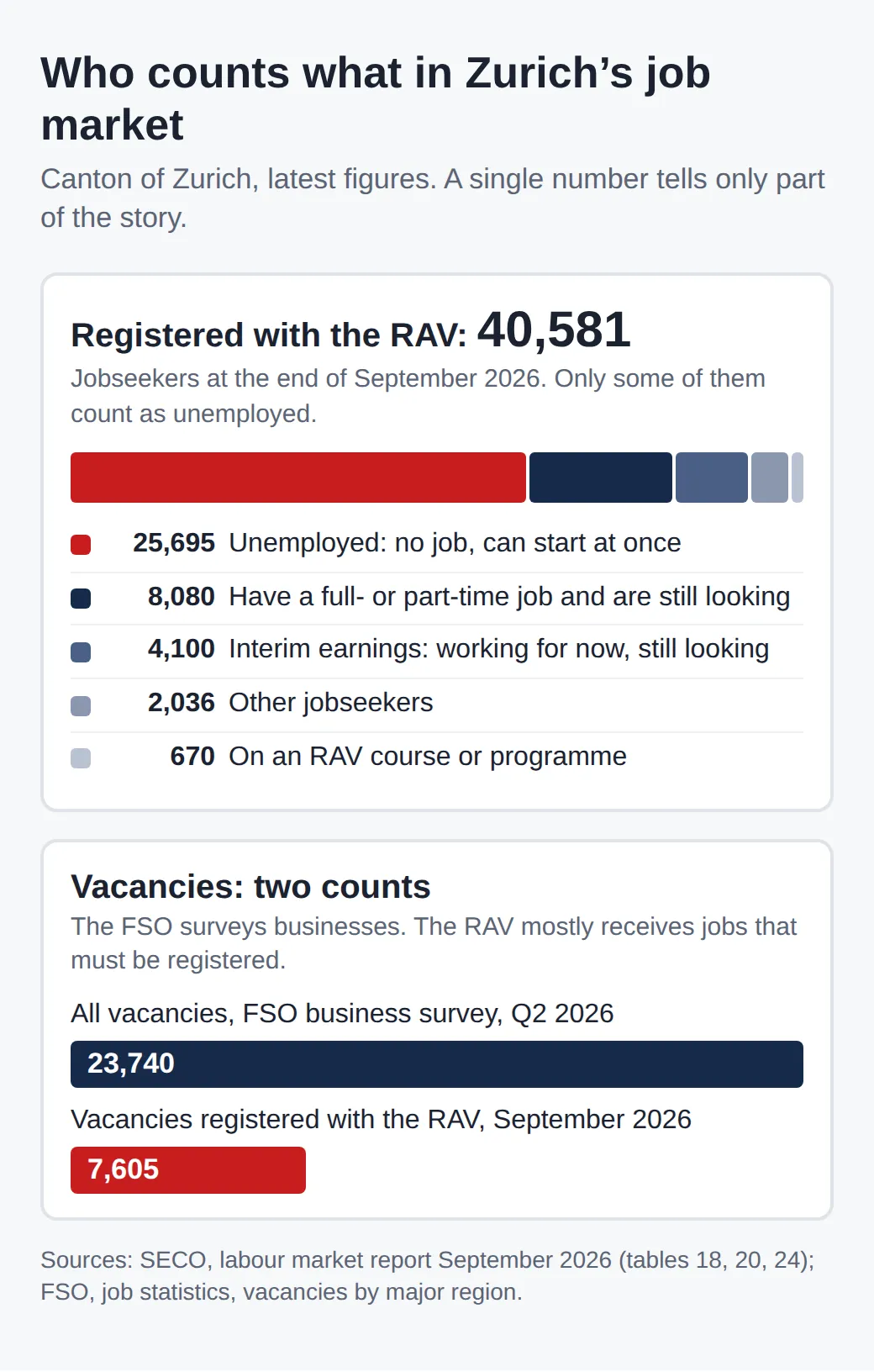
Vacancies come in two figures too, and they are far apart. Every quarter the FSO surveys businesses, and for the canton of Zurich it counted 23,740 vacancies in the second quarter of 2026. In September, 7,605 vacancies were registered with the RAV. That second number gets quoted a lot, but it only shows a slice. The RAV mainly receives jobs in occupations covered by the job registration requirement: nationwide, 29,251 of the 44,199 registered vacancies in September fell under it, two thirds.
The registration requirement also explains part of the increase. In the canton, RAV vacancies were 46 percent higher than a year earlier. According to SECO, 6.5 percent of the workforce worked in occupations subject to the requirement in 2025; in 2026 it is 10.8 percent. More occupations on the list means more registrations, even if employers aren't hiring more. If you want to know how much work there is, use the FSO figure. And that one tells a story that, at first sight, doesn't fit rising unemployment.
More jobs and more unemployed at the same time
Both are true at once: more people work in the canton of Zurich than a year ago, and more are unemployed. The FSO's job statistics count 1,167,570 people working in industry and services in the canton in the second quarter of 2026, 2.2 percent more than a year earlier. Over the same period, vacancies rose by 9 percent, from 21,700 to 23,740.
The market is still a long way from its post-pandemic peak, though. In the second quarter of 2022, the FSO counted 29,648 vacancies in the canton. Today there are about 20 percent fewer. The vacancy rate, meaning open positions as a share of all jobs, stood at 2.7 percent back then and is 2.0 percent today. The Swiss average is 1.7 percent. Measured against the number of people in work, Zurich still advertises more jobs than Switzerland on average.
Put the two sides next to each other and, on paper, there is a little over one unemployed person for every vacancy. At the end of June, 25,413 people in the canton were registered as unemployed, and the FSO counted 23,740 vacancies in the same quarter. That's our own calculation, and it only works on paper. A vacancy for a site foreman is no help to an unemployed banking specialist.
The canton's Wirtschaftsmonitoring economic report for September 2026 (in German) describes the mood soberly. Companies remain cautious about hiring, and a noticeable pick-up in the labour market is not in sight, it says; the steadier rate over the summer is probably more down to the season. A further FSO survey shows what businesses are planning: weighted by headcount, 11.6 percent of Zurich businesses wanted to take on more staff in the second quarter and 3.4 percent wanted to cut jobs. The large majority plan to keep their headcount steady. Where jobs are missing and where they are waiting shows up in the occupations.
Which jobs are hit and where employers are hiring
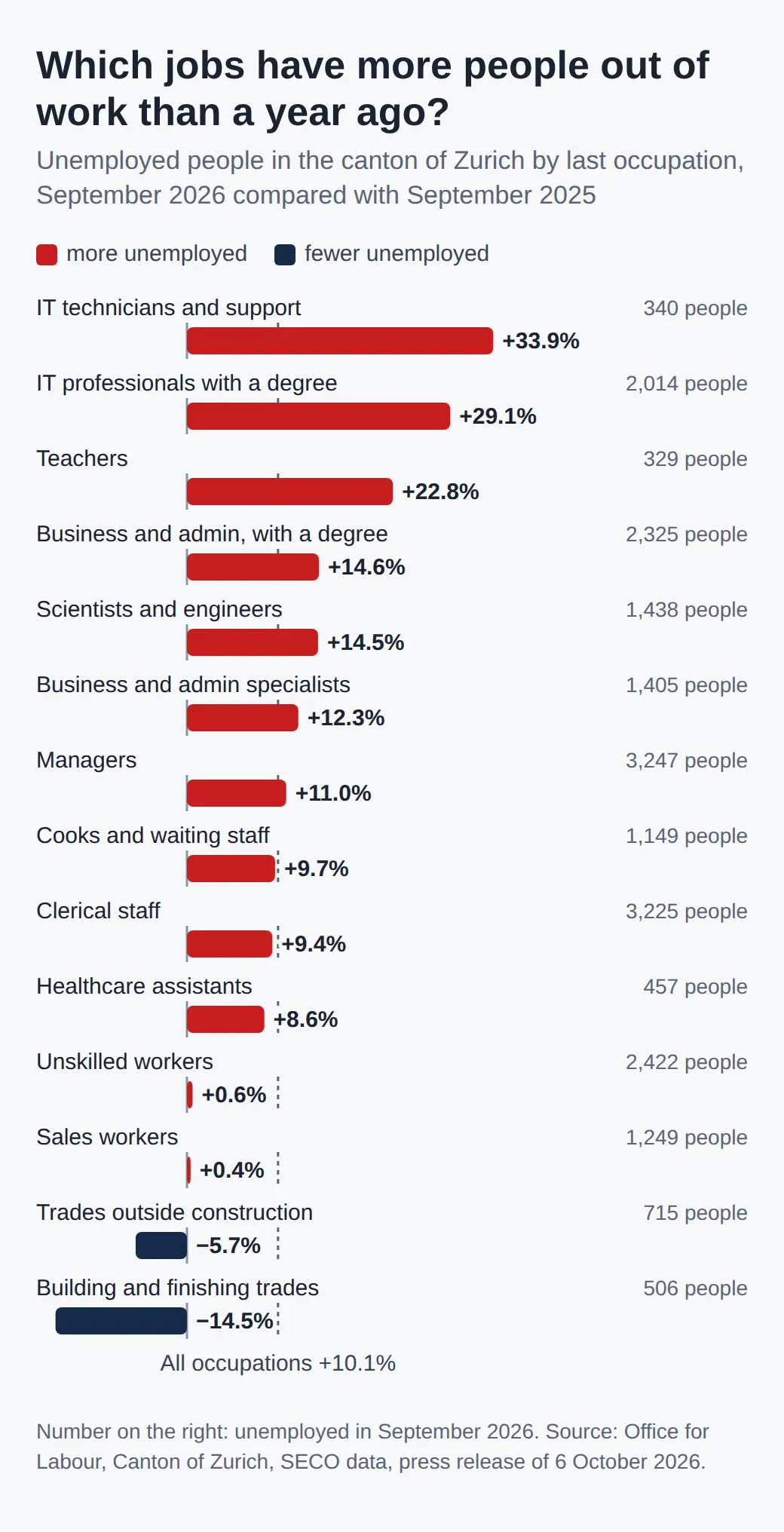
Unemployment has risen most in desk jobs and fallen in construction. That is what the Office for Labour's monthly tables (in German) show. They sort unemployed people by the occupation they last worked in and by the industry of their last employer.
IT, banking and office jobs
Among IT professionals with a university degree, 2,014 people were unemployed in September, 29 percent more than a year earlier and more than twice as many as in September 2023 (866). In IT operations and support the increase is 34 percent, from a smaller base. Counted by industry, unemployment in banking rose by 32 percent to 1,621 people, and in information and communication by 39 percent. Managers (up 11 percent) and clerical staff (up 9 percent) are also out of work more often.
One detail stands out. Counted by the industry of the last employer, the number of unemployed in IT barely changed over the past year, at 1,292. The rise there came earlier: it has gone up by two thirds since September 2023. So most of the IT specialists who became unemployed in the last year probably worked outside the IT industry, for example in a bank's IT department. That's our reading, since the tables count occupation and industry separately. What it means for you: with a profile in these fields, you are competing against far more people today than in 2023. That's no reason to switch fields, but it is a reason to apply in a more targeted way and to allow more time.
Construction and the trades
In construction it's the other way round. Among building and finishing trades workers, the number of unemployed fell by 15 percent within a year to 506, and in the trades outside construction by 6 percent. At the same time, employers registered more vacancies with the RAV: according to the Office for Labour, the biggest increases on the previous month were for building and finishing trades workers (up 206) and construction labourers (up 179). One caveat belongs here. Unemployment in construction rises every winter; in December 2025 it went up by 238 people in this industry alone. If you start looking in autumn, you get in ahead of the winter months.
Hospitality and retail
This is where the canton sees the weakest outlook. In the business survey, employment expectations improved slightly in several industries. The Office for Labour names hospitality and retail as the exceptions, where employers expect to employ fewer people rather than more. Among cooks and waiting staff, the number of unemployed rose by 10 percent to 1,149; among sales workers it barely changed. For hospitality, the economic report points to weaker demand from abroad, partly because of the strong franc and high prices. Which leaves the question of whether Zurich is still short of people at all.
Is there still a skills shortage in Zurich?
Yes, but less than in 2022. The most direct official measure is a question the FSO asks businesses every quarter: whether they found the staff they were looking for easily, with difficulty or not at all. Weighted by headcount, Zurich businesses answered like this (FSO):
| Qualification sought | Hard to find, Q2 2022 | Q2 2026 |
|---|---|---|
| University degree | 22.2% | 19.2% |
| Higher vocational education | 24.7% | 19.2% |
| Apprenticeship | 21.1% | 14.3% |
| Compulsory schooling | 5.8% | 4.2% |
Hiring has eased most for staff with an apprenticeship. The share of businesses that could not find staff with a completed apprenticeship at all fell from 4.4 to 2.5 percent, and for higher vocational education from 5.2 to 2.0 percent. For university graduates it stayed at 2.8 percent. So one in five businesses still struggles to find staff qualified above apprenticeship level. That more graduates are unemployed at the same time is only an apparent contradiction: employers are often looking for a different profile from the one that happens to be available.
The Office for Labour reached the same conclusion for 2025. In January 2026, its head, Hans Rupp, said the shortage of skilled workers had eased slightly in various industries, mainly because of the economic cycle. The job registration requirement sends a signal in the other direction. It applies to occupations where unemployment across Switzerland is at least 5 percent, in other words where there are more likely to be too many applicants than too few. New on the 2026 list are, for example, cooks and cleaning staff, both at 5.3 percent.
In the long run, the trend points back towards a shortage. A study by the canton (in German) expects Zurich to be about 300,000 workers short in 2050 because of the ageing population. Today's surplus in some occupations doesn't change that. The figures on how long people spend searching show who feels that surplus anyway.
Who is finding it harder right now
If you become unemployed today, you stay unemployed for longer. At the end of September, 4,316 people had been without a job for more than a year, 43 percent more than a year earlier. For durations of 7 to 12 months the increase was 18 percent, while for up to 6 months the number actually fell slightly. In September, 5,828 people newly registered with the RAV, about as many as a year earlier. So not many more people are coming in, but they take longer to find their way back into work.
Age plays a part too. Among 60- to 64-year-olds, the number of unemployed rose by 20 percent to 2,051, more than in any other age group. There were 3,263 unemployed people from management positions, 11 percent more.
Rates vary widely between districts. The rate is highest in Horgen and Dietikon, at 3.7 percent each. The city of Zurich, which is a district of its own, has 8,225 unemployed people and a rate of 3.2 percent, the same as Bülach. It is lowest in Hinwil at 1.7 percent and Andelfingen at 1.8 percent; Winterthur is at 2.6 percent.
With all these figures, it's worth looking at the other side: thousands of people find a new job every month. In September, 5,719 people in the canton deregistered from the RAV, 3,190 of them because they had found a job. That's more than in September 2025, when it was 2,686.
What this means for your job search
Right now the market mostly rewards speed and breadth. That starts with registering early with the RAV. Jobs covered by the registration requirement appear in the public employment service's system first. According to the Canton of Zurich (in German), employers then have to wait five working days, and during that time only jobseekers registered with the RAV can apply. You can register even while you still have a job: in the canton, more than 8,000 people do. SECO's overview of the job registration requirement tells you whether your occupation is on the list.
If you have been looking for a while, it's better to build a bridge than leave a gap. The figures on duration show that many people now search longer than a year ago. A temporary assignment or interim earnings keep gaps out of your CV, and 4,100 jobseekers in the canton are taking exactly that route.
It also pays to look beyond your own industry. Our post on the largest employers shows who employs the most people in the canton. How the canton and the city set pay is covered in the post on salary classes. And before you accept an offer, compare it with salaries in Zurich by industry: if you're searching under pressure, it's easier to sign for less than you're worth.
When the next figures come out
SECO and the Office for Labour publish the unemployment figures every month, in the first few days of the following month: the September figures, for instance, came out on 6 October. The FSO's vacancy figures and surveys appear quarterly.
For the coming months, one thing is predictable: the rate is likely to rise over the winter, as it does almost every winter. In December 2025 it went up from 2.7 to 2.9 percent, and the Office for Labour called that largely seasonal. Don't let news like that discourage you; compare with the same month of the previous year or with the seasonally adjusted figure instead. Only a comparison over several months shows whether things are really getting worse. You'll find open jobs in Zurich on our site by field, for example in trades and construction, in healthcare or in operations and administration.
Common questions
- Do I count as unemployed if I don't get unemployment benefits?
- Yes, as long as you are registered with the RAV, have no job and could start straight away. Whether you receive money from unemployment insurance makes no difference to SECO's statistics. If you never register with the RAV, though, you don't appear in any of these figures.
- Why does unemployment in Zurich go up every winter?
- Mainly because of construction. In December 2025, construction alone added 238 unemployed people, and the Office for Labour called the rise largely seasonal and normal for the winter months. So always compare with the same month of the previous year or with the seasonally adjusted figure.
- What does seasonally adjusted unemployment mean?
- The statistics strip out the swings that come back at roughly the same size every year, such as winter on building sites or apprentices finishing their training in summer. What is left shows the real direction. In September 2026, the seasonally adjusted number of unemployed people in the canton fell by 171.
- How many people work in the canton of Zurich?
- According to the Federal Statistical Office's job statistics, 1,167,570 people worked in industry and services in the canton in the second quarter of 2026, or just under 900,000 full-time equivalents. That is about one fifth of everyone employed in Switzerland. Agriculture is not included.
More posts
All posts
Average Salary in Zürich? The Median by Industry, 2024
Median salary in Zürich in 2024: CHF 8,508 a month in the city, CHF 7,502 in the canton. By industry, age and gender, with gross and net explained.

Zurich Labour Court 2026: Process, Deadlines and Costs
A dispute over pay, a reference or dismissal? How to get from the justice of the peace to Zurich's labour court, which deadlines apply and what it costs.

Minimum Wage in Zürich: CHF 23.90, Who Gets It and When
Zürich's minimum wage is CHF 23.90 an hour, Winterthur's CHF 23. What the Federal Supreme Court ruled, who gets it, the exceptions and when it starts.