Canton of Zurich Salary Classes 2026: How Your Pay Is Set

At a glance
The Canton of Zurich places every job in one of 29 salary classes. In 2026 it pays between CHF 46,546 a year (class 1, lowest entry step) and CHF 292,819 (the top of class 29) for a full-time post, 13th monthly salary included. From 1 January 2027 a 0.8% cost-of-living increase is added. Where you start within your class depends mainly on your credited experience: as a rule, one salary step per full year.
The City of Zurich works differently. It has 18 function levels and counts experience in points from 0 to 25. Its 2026 pay scale runs from CHF 57,490 to CHF 257,457 a year. We walk you through both systems with the official tables and the rules from personnel law, and work through an example so you know your likely step before the interview. The canton and the city are the two largest employers in Zurich, so a lot of local jobs are paid by these two tables.
Class and step: two separate decisions
Your pay at the canton is set in two stages, and only the second one depends on you. First the post is graded: it gets a salary class. Then the person is placed: you get a salary step within that class. That's how the canton describes it on its page on pay and other benefits (in German, like all the official pages linked here).
The class depends only on what the job demands, not on who fills it. The Personnel Ordinance lists the criteria: the training and experience required, the mental demands, responsibility, psychological and physical strain, and any special working conditions. The method is called «Vereinfachte Funktionsanalyse», a simplified job evaluation. That's why there's little room to negotiate the class: it's in the staffing plan before you apply.
Each class has 29 salary steps, except class 28 with 27 and class 29 with 25. Below step 1 sit two entry steps, roughly 7% and 3.5% lower. The top of a class is about 146% of its minimum. Your annual salary is paid in 13 equal parts, twelve of them monthly. And every amount assumes 42 hours a week, the full working time at the canton. With these rules in mind, the tables make sense.
Salary table 2026: what each class pays
The 29 salary classes overlap a lot: the upper steps of one class pay more than the start of the next. In the lower classes, step 1 is only a few hundred francs above the class below. At the top the gap is almost CHF 14,000.
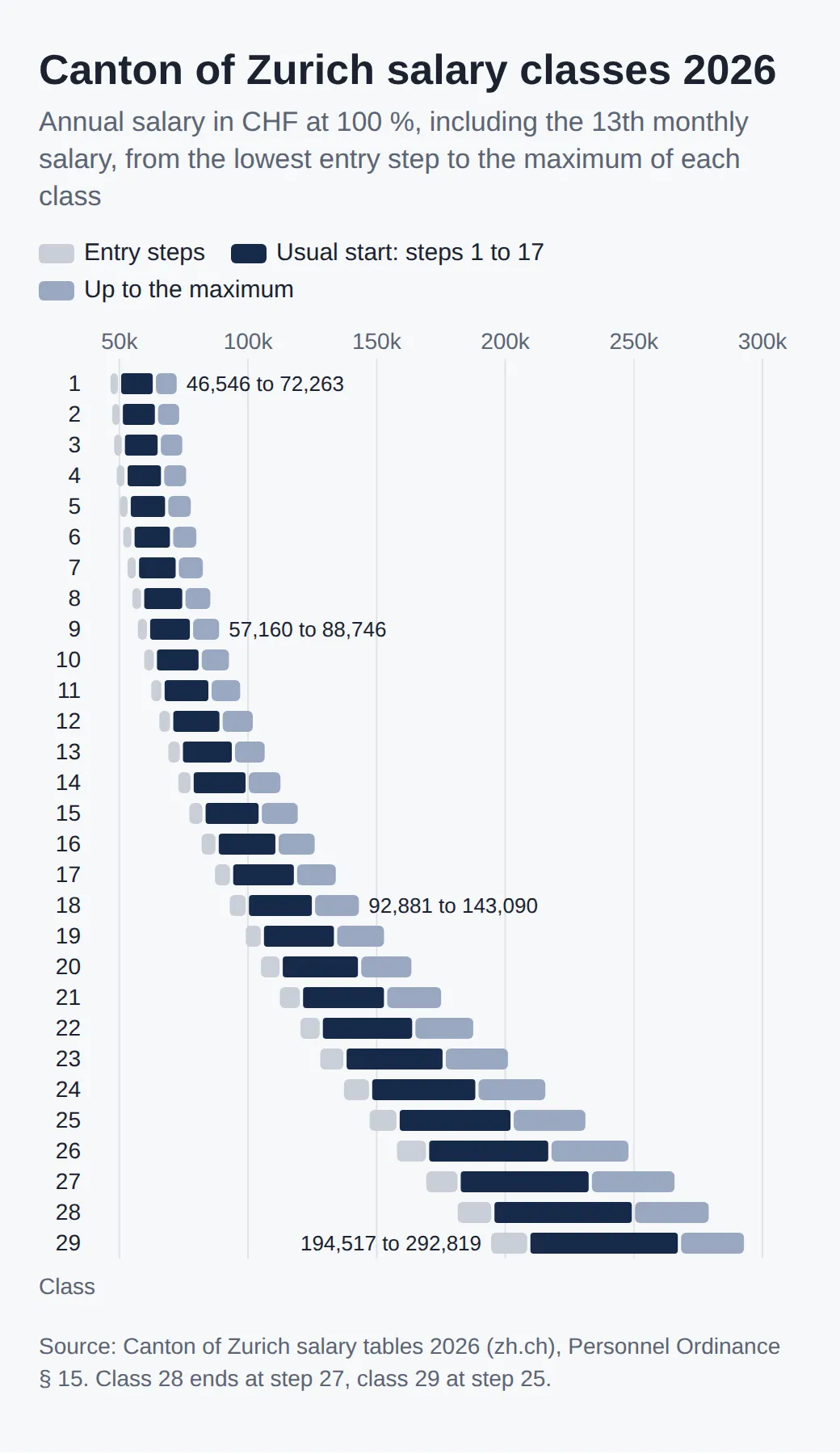
The canton publishes a separate page for each class. The table for class 9, for example, gives a base salary of CHF 61,332 a year for step 1. That's CHF 4,717.85 a month, paid 13 times. In this class, one step up is worth between CHF 895 and 1,044 a year. The table also shows the salary insured with the pension fund and the pay per working day.
The 2026 amounts are 0.2% higher than in 2025. That's the cost-of-living adjustment the cantonal government granted in its decision of 24 September 2025. In class 9 it lifted step 1 from CHF 61,210 to 61,332. The government sets the adjustment every year based on the Swiss consumer price index at the end of August, and it applies from 1 January. For 2027 it decided on 30 September 2026 to grant an increase of 0.8%. So the tables in this article apply until the end of 2026, after which every amount is 0.8% higher.
If you compare the tables with general salary statistics, you need to convert. The statistics assume 40 hours a week, the canton 42. Converted to 40 hours, a cantonal salary is worth about 95% of the table figure (40 divided by 42). Our article on salaries in Zurich shows where median pay sits. That leaves the question of which class your job is in.
Which job sits in which class
Which role belongs in which classes is set out in the grading plan. It's Annex 1 of the Implementing Ordinance to the Personnel Act, and for each class it lists the matching benchmark positions (Richtpositionen), model roles in effect. Most benchmark positions appear in several classes. The suffix «mbA» means "with special duties" and marks the more demanding version of the same role.
| Benchmark position | Classes | Annual pay 2026, step 1 to maximum |
|---|---|---|
| Healthcare assistant (FaGe) | 9 to 10, special duties 11 to 13 | CHF 61,332 to 106,477 |
| IT specialist | 9 to 12, special duties 13 to 15 | CHF 61,332 to 119,340 |
| Police officer | 14 | CHF 78,250 to 112,581 |
| Registered nurse (HF) | 14 to 15, special duties 16 | CHF 78,250 to 125,931 |
| Social worker | 16 to 17, special duties 18 to 19 | CHF 87,990 to 152,874 |
| Research associate | 16 to 20, special duties 21 to 23 | CHF 87,990 to 201,049 |
| Junior doctor | 19 to 21 | CHF 105,576 to 175,068 |
| Public prosecutor | 24 to 25 | CHF 147,653 to 231,176 |
Each range runs from step 1 of the lowest class to the maximum of the highest. An actual job, though, has only one class. The canton's personnel law handbook states that the class and benchmark position of every post are recorded in the staffing plan. So you can ask, and the answer is a number. The second stage is the more interesting one, because that's where your CV counts.
How your salary step is worked out
Your starting step comes from your credited years of experience: you start at step 1 and, in principle, move up one step for each fully credited year. The Personnel Ordinance sets the starting salary "as a rule" within steps 1 to 17. Under § 15, what counts is experience in earlier jobs, proven skills and particular suitability, and housework, child-rearing and care work are also taken into account appropriately.
How this turns into years is set out in the personnel law handbook, which the canton publishes for its HR staff. Two things shrink your years. First, experience counts in proportion to your workload: two years at 50% make one year. Second, each job is weighted by how close it is to the new one.
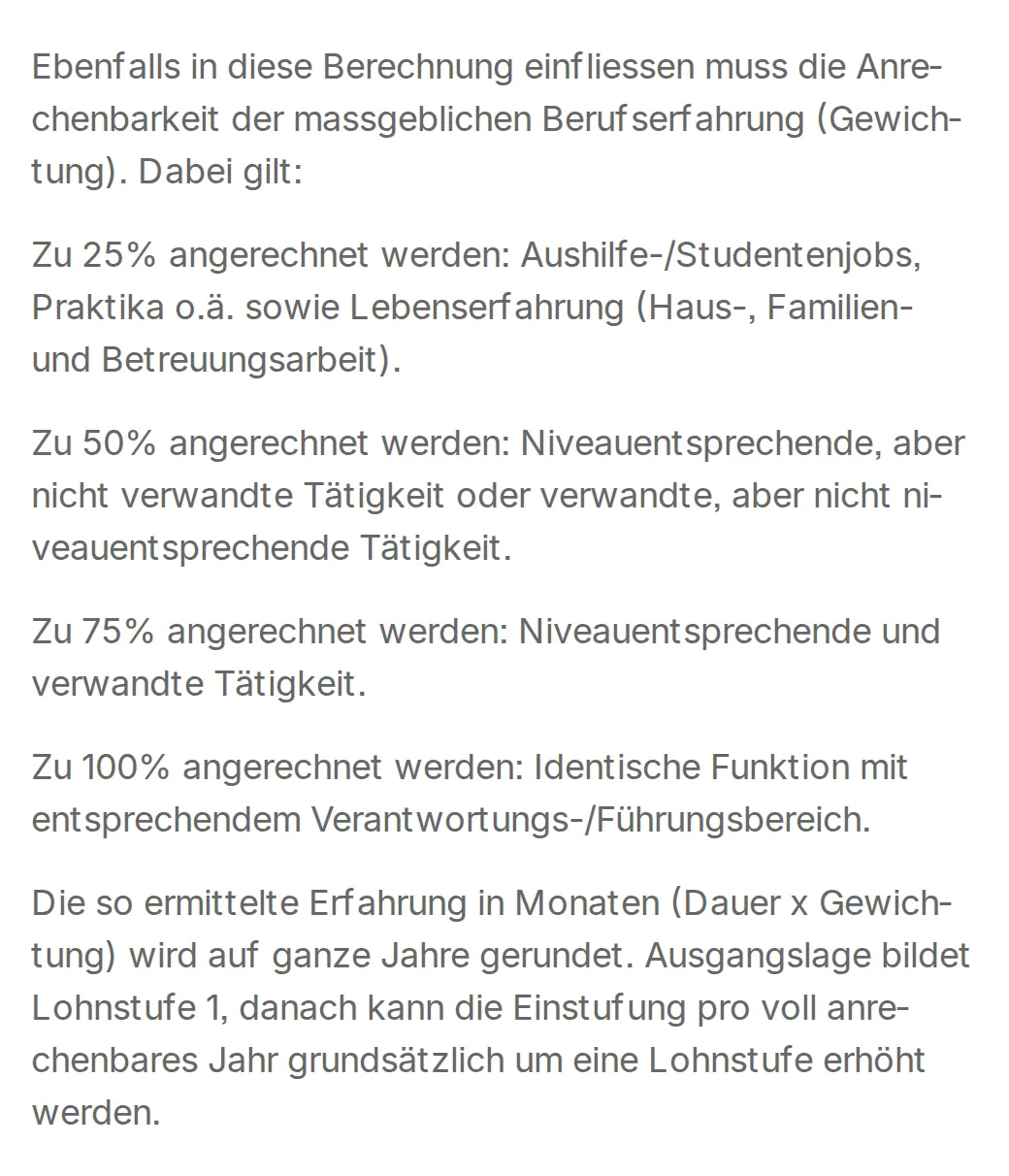
So internships and student jobs count for a quarter, and so does family work. A job at the same level in a related field counts for three quarters, and only the same role with the same responsibility counts in full. The months are added up and rounded to whole years.
On top of that comes further training that the class doesn't require but that helps in the job. The handbook gives a Master of Advanced Studies as an example and uses one step as a guideline for it, and two for a doctorate. Finally, HR compares you with staff in the same class and benchmark position, in the unit, the office or the directorate. If your offer comes in lower than your own calculation, this comparison is often the reason.
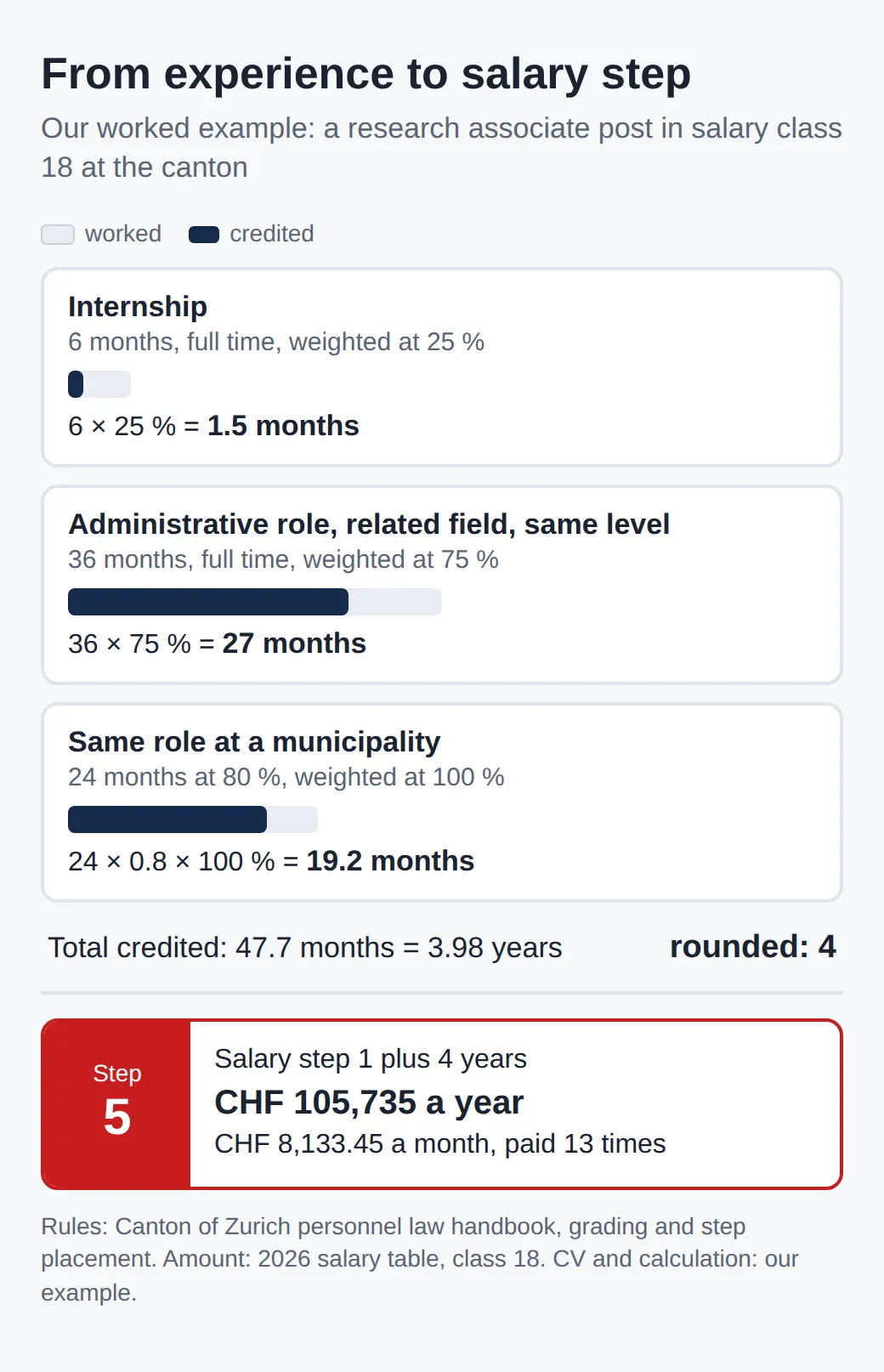
In the example the CV shows five and a half years, and just under four are credited. With only 41 months, the total would have rounded down to three years and step 4. That's why it pays to send your work references (Arbeitszeugnisse) with dates and workload: the calculation needs exactly that information.
Entry steps: when you're not quite there yet
If you don't yet have the required training or experience, your pay starts at one of the two entry steps. The same applies if you need a particularly intensive induction or take on the role with limited responsibility at first. In class 18 the lower entry step is CHF 92,881, and step 1 is CHF 99,740. The Personnel Ordinance requires your pay to reach the regular steps within three years. After that, it moves up another way.
How your pay rises at the canton
There's no automatic step for each year of service at the canton. Your pay grows in two ways: through the cost-of-living adjustment the government decides each year, and through what's called an individual salary increase.
That increase requires a performance review. With a rating of «gut» (good), the canton can move you up by up to two steps per calendar year, with «sehr gut» (very good) by up to five, each time up to the top of the class. The regular date is 1 April. If you've reached step 25 and get a very good rating, you can also move up to a "performance class", the next salary class up. But all of this depends on a budget: each year the government decides what share of the payroll is available for individual increases, and for 2027 it's 0.7%. A good rating is a precondition, not an entitlement.
For your planning, that means the step you start on shapes your pay for years. A step you miss at the start can only be made up through good reviews and available funds. The City of Zurich has solved this problem differently.
The City of Zurich: 18 function levels and experience points
At the city, your pay depends on three things: the function level of your job, your "usable experience" and your performance. The city's pay system places every role in one of 18 levels, and each level has a pay band.
The rules are in the city's personnel regulations. The minimum of a function level is called the function salary. Usable experience is scored from 0 to 25 and raises the band by at most 25% of the function salary. The top of the band is always eleven ninths of the bottom, so just over 22% higher. Where you land between the two is decided by performance.
Unlike at the canton, experience rises automatically: according to the implementing provisions, your score goes up by one point at each annual pay round until it reaches 25. The band moves with it, by 1.9% for each of the first five points, more slowly after that. When you join, the city credits professional and non-professional experience, explicitly including volunteer and family work. If you don't yet meet the requirements, you can start one function level lower and usually move to the right one after one year, two at most.
| Function level | Minimum, no experience | Maximum, 25 points |
|---|---|---|
| 1 | CHF 57,490 | CHF 65,902 |
| 2 | CHF 57,490 | CHF 70,583 |
| 3 | CHF 57,490 | CHF 76,393 |
| 4 | CHF 57,490 | CHF 83,256 |
| 5 | CHF 59,651 | CHF 91,133 |
| 6 | CHF 65,452 | CHF 99,996 |
| 7 | CHF 72,015 | CHF 110,023 |
| 8 | CHF 79,350 | CHF 121,229 |
| 9 | CHF 87,366 | CHF 133,476 |
| 10 | CHF 96,068 | CHF 146,771 |
| 11 | CHF 105,568 | CHF 161,284 |
| 12 | CHF 115,883 | CHF 177,043 |
| 13 | CHF 126,912 | CHF 193,893 |
| 14 | CHF 138,776 | CHF 212,019 |
| 15 | CHF 151,372 | CHF 231,263 |
| 16 | CHF 164,821 | CHF 251,810 |
| 17 | CHF 179,025 | CHF 257,457 |
| 18 | CHF 194,102 | CHF 257,457 |
The figures come from the pay scale of 1 April 2026 and apply to a full-time post, including the 13th monthly salary, which the city pays in November. Two limits shape the table. At the bottom there's a city minimum wage: the personnel regulations set it at CHF 54,600 plus inflation, which in 2026 is CHF 57,490, or CHF 4,422.30 a month, and it lifts pay in levels 1 to 4. At the top, the regulations cap any salary at CHF 220,000 plus inflation since 1999, which in 2026 is CHF 257,457. That's why levels 17 and 18 end at the same amount.
The city adjusts for inflation each year on 1 April, in 2026 by 0.1% under a City Council decision of 18 March 2026. On the same date, managers review every salary, taking into account performance and conduct, where you sit in the band, and experience. What the city doesn't show on its pay page is which role sits at which level. But the implementing provisions give you the right, when you start, to a conversation about how your role is classified and how your pay may develop. Beyond pay, the two employers also differ on holidays and leave.
Holidays, working hours and benefits compared
Both employers work on a 42-hour week, but they take different paths on holidays and parental leave. The details come from the canton's pages and the city's pages on holidays and leave and employment.
| Canton of Zurich | City of Zurich | |
|---|---|---|
| Holidays, age 21 to 49 | 25 days | 4 weeks, plus 6 days of company holiday |
| Holidays from 50 and from 60 | 27 and 32 days | 5 and 6 weeks |
| Maternity leave | 16 weeks paid | 16 weeks, plus 3 weeks before the birth |
| Paternity leave | 2 weeks paid, 1 month unpaid | 4 weeks paid |
| Long service, after 10 years | 15 working days of paid leave | one extra month's salary |
| Pension fund | BVK | Pensionskasse Stadt Zürich |
| Notice period after probation | 1 to 6 months, by years of service | 1 month in the first year, then 3 |
At both, probation usually lasts three months, with seven days' notice. At the canton, notice then rises in stages to six months from the tenth year of service, as set out in the Personnel Act. Sick pay rules differ too. In the first year of service the canton pays three months at full salary and another three months at 75%, and from the third year twelve months at full salary. After the first year of employment the city pays 180 days at full salary and then up to 550 days at 80%.
Then there are smaller contributions. The canton pays half the premium for non-occupational accident insurance. Where there's no subsidised staff canteen, full-time staff get a Lunch-Check card worth CHF 250 a month, half of which you pay yourself. The city pays a mobility contribution of up to CHF 600 a year, as Reka-Rail credit or towards your own bike. How much of your gross salary you keep then depends mainly on your taxes. If you work without a C permit, you'll find the details in our article on withholding tax in Zurich.
How to apply to the canton and the city
At both the canton and the city, you apply online for an advertised job. The Personnel Act requires the canton to advertise vacancies publicly as a rule, and it collects them on its own job portal. With your application you submit proof of your training and your previous work. For your step placement these are the most important documents, and they should show the length and workload of each job.
The city sets out its process in detail on its application page. You apply through the «Bewerben» (apply) button in the job ad; the city doesn't accept applications by email. You create an applicant account and upload your documents as PDFs, 10 MB at most. You decide whether only the hiring managers for that job can see your profile, or all of the city's recruiters. The city only contacts referees with your consent, and it deletes your documents six months after you apply. There's no central address for speculative applications; the individual departments handle them. The city advertises apprenticeships from 1 August for the following year.
For some jobs the city may ask for a criminal record extract, and it refunds the cost. For police, driving roles, management posts and educational, childcare and social-therapy roles, it can also obtain a police conduct report, but only with your written consent.
In the interview, raise pay directly, because it follows from rules rather than from bargaining skill. You could put the question like this:
Could you tell me which salary class and benchmark position the job is graded in, and which salary step you're offering me? I'd also like to know how you weighted each of my previous jobs.
At the city, ask instead about the function level, the score for your usable experience, and where your offer sits in the pay band.
What you can still influence on pay
Little on the class, quite a lot on the step. The city itself says that it hires by official ruling (Verfügung) rather than an employment contract, and that the room for negotiation is therefore small. It's similar at the canton: the class of the post is fixed before you apply.
Your step placement, on the other hand, is a calculation built on assumptions, and assumptions can be corrected. Check that each previous job was counted at the right weighting. A job at the same level in a related field counts at 75%, not 50. Years of family and care work count for a quarter at the canton, and at the city as non-professional experience if they're useful for the role. And further training the job doesn't require can bring an extra step. Back it up with references and show the months yourself, as in the example above.
It all starts with the job, though. Work out which step your CV gives you, look up the table for your class or function level, and go into the interview with that number. You'll find open positions in administration under operations and admin, and jobs in hospitals and care homes under healthcare.
Common questions
- Do I need Swiss citizenship to work for the Canton or City of Zurich?
- Usually not. The canton requires Swiss citizenship only for posts that exercise sovereign powers, and it can grant exceptions in individual cases. At the City of Zurich the requirement applies only to armed police service and to civil registry officers.
- How do I work out a part-time salary from the salary table?
- Every amount in the tables is for a full-time post. At 60 percent you get 60 percent of the figure for your class and step. At the canton, your holiday entitlement is also prorated to your workload.
- Do canton and city employees in Zurich get a bonus?
- There's no contractual bonus of the kind many companies pay. For outstanding work the canton can pay one-off awards of CHF 500 to 8,000 a year, or grant extra days off or gifts in kind, and the city can pay one-off cash or in-kind awards. Both are one-off recognition, not a fixed part of your pay.
- Do the canton's salary classes apply to teachers?
- Not entirely. Teachers covered by the cantonal Teaching Staff Act have their own rules, for example on working hours. If you apply to a school, ask directly about the grading and which regulations apply.
More posts
All posts
Minimum Wage in Zürich: CHF 23.90, Who Gets It and When
Zürich's minimum wage is CHF 23.90 an hour, Winterthur's CHF 23. What the Federal Supreme Court ruled, who gets it, the exceptions and when it starts.

Zurich Labour Court 2026: Process, Deadlines and Costs
A dispute over pay, a reference or dismissal? How to get from the justice of the peace to Zurich's labour court, which deadlines apply and what it costs.

Daycare Costs in Zurich 2026: Fees, Subsidies, Tax Deduction
Subsidised daycare (Kita) in Zurich costs CHF 12 to 120 a day in 2026. How the city sets your fee, what you can deduct and what an extra workday costs.