Minimum Wage in Zürich: CHF 23.90, Who Gets It and When

Where things stand
The minimum wage in the city of Zürich is CHF 23.90 gross an hour, and in Winterthur it's CHF 23. Since the Federal Supreme Court ruled on 12 May 2026, both sets of rules are valid. But they aren't in force yet: the City Council sets the start date, and Zürich says it will announce it at least six months ahead.
Until then, your pay stays the same. It's still worth knowing the rules now. In September 2026 the City of Zürich explained how it reads some cases, such as students with a Matura or retirees with a side job. And in Bern, a federal law is waiting that could override the minimum wage for whole industries before it even applies. We draw on the two cities' ordinances, the Federal Supreme Court's rulings and the City Council's answers. Most of these sources are in German.
Does the minimum wage apply in Zürich yet?
No. The ordinance is valid, but the City Council hasn't brought it into force. It has to do that explicitly, as the ordinance's last article says. On its minimum wage page, the city says it hasn't yet decided when that will happen.
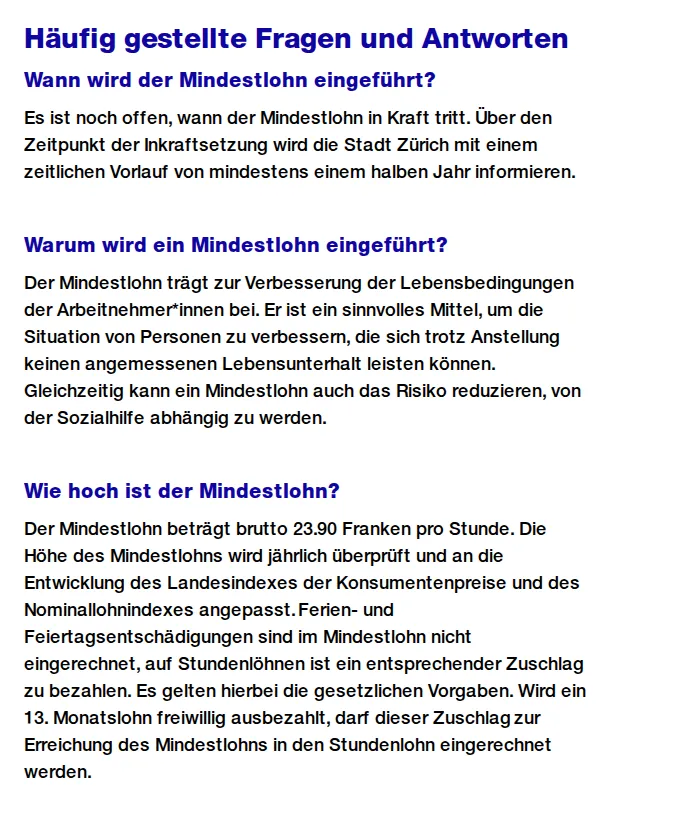
The second sentence of that answer is the one that matters: the city will give at least half a year's notice. By mid-October 2026 it hadn't named a date. Even with an announcement in autumn 2026, the start would be spring 2027 at the earliest. That gives employers time to adjust their pay, and it gives you time to work out your own hourly rate.
The city is now working on the implementing provisions, the detailed rules that will apply alongside the ordinance. The timetable is part of that. Winterthur is in a similar place: according to its minimum wage page, the city is drafting the ordinance with the details and says nothing changes for employers or employees until then. The reason it's taking so long is a legal dispute that ran for three years.
What the Federal Supreme Court decided
The Federal Supreme Court ruled that municipalities in the canton of Zürich may set their own minimum wage. It was a long road. The initiative «Ein Lohn zum Leben» ("a wage to live on") was submitted in Zürich, Winterthur and Kloten on 10 November 2020. In Zürich, the City Parliament adopted a counter-proposal on 1 March 2023, with CHF 23.90 instead of the CHF 23 the initiative asked for. On 18 June 2023 the city's voters approved it by 75,170 votes to 33,099, or 69.43%. Winterthur said yes on the same day, with 65.52%.
An association, not named in the ruling, had already appealed in April 2023. The District Council dismissed the appeal. The Administrative Court of the Canton of Zürich then sided with the association on 17 September 2024 and struck down the ordinance: municipalities, it said, had no basis in cantonal law for a minimum wage. A minority of the judges disagreed even then. The court ruled the same way against Winterthur that day.
Both cities appealed, and the Federal Supreme Court upheld their appeals. In ruling 2C_28/2025, it found that a municipality doesn't need an express basis in the cantonal constitution to take on a new public task. Municipalities in Zürich have very wide autonomy, it said. On top of that, the constitution commits the Confederation, the canton and the municipalities to the goal that people who are able to work can live on what they earn. Whether a minimum wage is compatible with economic freedom was no longer in dispute. The Administrative Court had already accepted that, based on earlier rulings on Neuchâtel and Ticino.
The consequence is spelled out in the ruling itself: the ordinance of 1 March 2023 is revived, and it's up to the City Council to bring it into force. The association pays the court costs of CHF 5,000. The same applies to Winterthur in ruling 2C_30/2025. Both rulings are dated 12 May 2026, but they were made public with the Federal Supreme Court's press release on 10 June 2026. That's why many reports give both dates. The main question left is exactly who the minimum wage covers.
Who gets the minimum wage
The minimum wage applies to everyone who does most of their work within the city of Zürich. Going by the wording, what counts is where you work, not where you live and not where the company is based. If you live in Winterthur and work in a Zürich hotel, you're covered. If you live in Zürich and work as a cleaner in Schlieren, you're not.
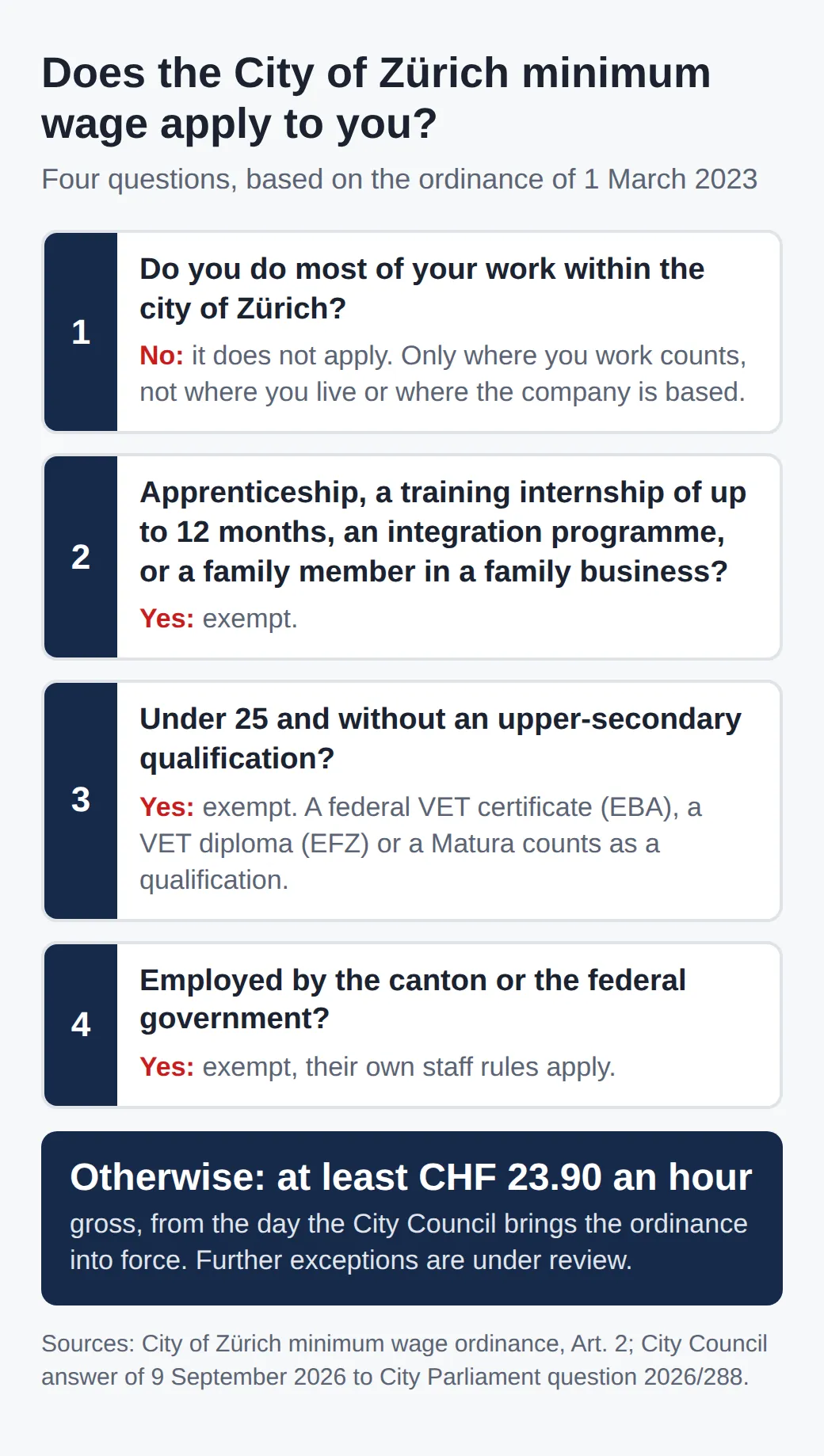
The rule applies in every industry, including those where a collective labour agreement (CLA, in German GAV) or a standard employment contract (NAV) sets its own minimum wages. That's stated in the 2023 voting booklet. A CLA is an agreement between unions and employers for a whole industry; a standard employment contract is a set of rules the state issues for an industry without one. If their minimum is lower, the higher amount applies in the city.
Before the vote, the city estimated who would be affected. Of around 385,000 people working in the city, some 16,800 earned less than CHF 23 an hour at the time, about 4%. Two thirds of them were women. Many worked in cleaning and facility services, gardening and landscaping, restaurants and retail.
In September 2026 the City Council clarified some cases in its answer to a question from the City Parliament. Retirees with a side job are in principle entitled, because the ordinance has no upper age limit. People who provide services for the city itself, for example as staff of a contracted firm, are also covered if the work takes place within the city limits. And platform drivers are entitled if they count legally as employees.
The exceptions
The ordinance explicitly excludes six groups:
- Internships with a training purpose, lasting at most twelve months
- Apprentices in recognised training companies
- Family members working in a family business
- Participants in vocational and social integration programmes
- People under 25 without at least a Federal VET Certificate (EBA)
- Employees of the canton and the Confederation, who fall under their own staff rules
The exception for under-25s is narrower than it sounds. The City Council counts any upper-secondary qualification, including an apprenticeship with a Federal VET Diploma (EFZ) or the academic Matura. So a 20-year-old student with a Matura who works part-time in a café is entitled to CHF 23.90. A 19-year-old without a qualification in the same café isn't. The idea behind it: a casual job shouldn't be more attractive than an apprenticeship. For internships, the city plans to check that the training purpose is documented, so that an internship isn't used as a cheap job.
The City Council can add further exceptions. It's currently looking at exceptions for childminders, side jobs, people with a disability and paid work of a voluntary nature, for example in church parishes. None of this has been decided. It can also grant firms that can show they're in financial difficulty a two-year deferral on request. So you'll only find out after the start whether that affects your employer. But you can already work out what the amount means for your pay.
What CHF 23.90 means per month
For a full-time job of 42 hours a week, CHF 23.90 an hour works out to at least CHF 4,349.80 gross a month, paid twelve times a year. The calculation is simple: hourly rate times weekly hours times 52 weeks, divided by 12. If your employer pays a 13th salary, the city says it may count it. Then a lower monthly salary is enough:
| Hours a week | Minimum per month, 12 salaries | Minimum per month, 13 salaries |
|---|---|---|
| 40 | CHF 4,142.67 | CHF 3,824.00 |
| 41 | CHF 4,246.23 | CHF 3,919.60 |
| 42 | CHF 4,349.80 | CHF 4,015.20 |
All amounts are gross. Social security (AHV), the pension fund and, if it applies to you, withholding tax still come off. Under the ordinance, pay means the wage subject to AHV contributions. Holiday and public holiday pay aren't included. If you're paid by the hour, you get surcharges on top: 8.33% for four weeks of holiday, 10.64% for five weeks, plus a separate surcharge for paid public holidays, following the table in SECO's information sheet. With four weeks of holiday, CHF 23.90 becomes CHF 25.89 an hour, not counting public holidays.
Who would get more
The difference shows most clearly in industries whose CLA or standard employment contract sits below CHF 23.90. In hospitality, the minimum wage under the L-GAV, the industry's CLA, is CHF 3,713 a month in 2026 for staff without vocational training, plus a full 13th salary. At 42 hours a week, the L-GAV's standard, that comes to CHF 22.10 an hour by our calculation. Small businesses may require up to 45 hours, which pushes the hourly rate lower still. Under the city minimum wage it would be at least CHF 4,015.20, paid 13 times a year: CHF 302.20 more a month, or CHF 3,928.60 more a year. If you have a two-year apprenticeship with an EBA, the L-GAV already puts you above that, at CHF 4,070 for 42 hours.
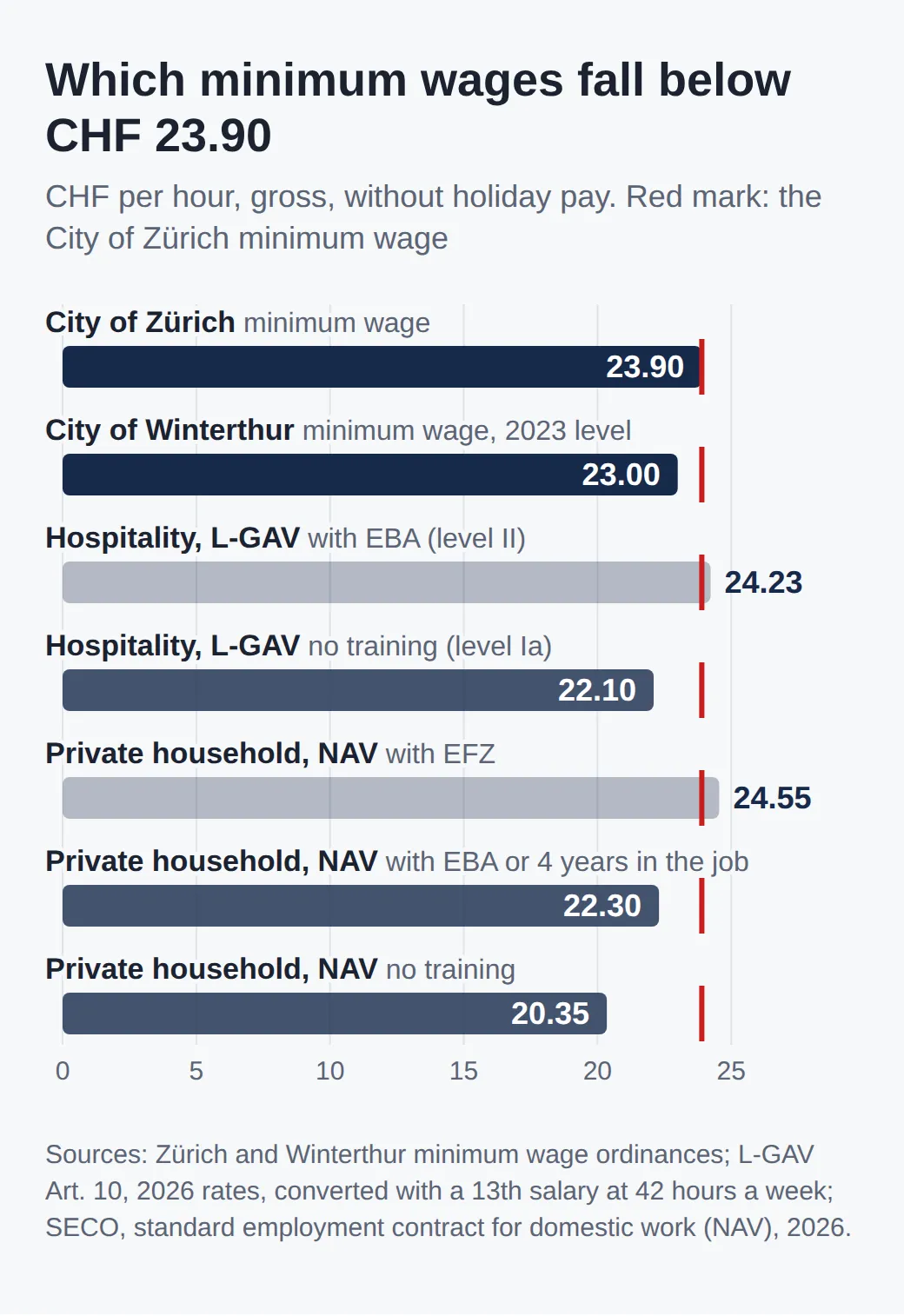
The gap is even bigger in private households. If you clean, do laundry or cook in a Zürich private household, on average at least five hours a week for the same household, you currently fall under the federal standard employment contract for domestic work. It excludes childminders and babysitters. In 2026 it requires CHF 20.35 an hour for staff without training, and CHF 22.30 with an EBA or four years' experience. A private household is an employer too. With the city minimum wage, the floor for this work would rise to CHF 23.90. Whether there will be an exception for childminders is something the city is still looking at. For average pay in Zürich, see our post on salaries in Zürich. Winterthur, meanwhile, has some rules of its own.
Zürich and Winterthur compared
The two cities have different ordinances, even though they go back to the same initiative. Zürich adopted a counter-proposal that the City Parliament had raised from CHF 23 to CHF 23.90; Winterthur adopted the initiative itself. The main differences are in the Federal Supreme Court's rulings, which quote both texts in full:
| Point | Zürich | Winterthur |
|---|---|---|
| Amount | CHF 23.90 an hour | CHF 23 an hour |
| Who | Work mostly in the city | Employment in the city |
| Under 25 without qualification | excluded | not excluded |
| Holiday job under 18 | no specific rule | excluded |
| Indexation | from 2.5% since January 2024 | every year since November 2019 |
| CLA industries | covered at once | one year to adjust |
In both cities, internships of up to twelve months, apprentices and family members in a family business are exceptions. Both bar employers who seriously or repeatedly break the rules from public tenders for one to five years. The row with the biggest consequences is indexation, because it decides whether the amount at the start is still CHF 23.90 or CHF 23.
When the amount goes up
In Zürich, the minimum wage doesn't rise automatically every year. The ordinance says the City Council reviews it annually. It takes the average of inflation and wage growth and raises the amount on 1 January once that average, counted since January 2024, adds up to more than 2.5%. Only then is there a jump.
We can roughly estimate how close that threshold is. The Federal Statistical Office reports inflation of 1.1% and nominal wage growth of 1.8% for 2024, and 0.2% and 1.8% for 2025. Simply adding the annual averages, 1.45% and 1.0%, gives about 2.45%, just under the threshold. But that's only our rough calculation. The ordinance uses the index level of January 2024 as its base, and the office reports wage growth only as an annual figure. The city hasn't published how it combines them. So it's not yet clear whether the amount will still be CHF 23.90 at the start.
Winterthur, by contrast, adjusts its amount every year as soon as the average is positive, counted from November 2019. Prices and wages have risen since then. If the city counts those years at the start, the amount will be above CHF 23. It hasn't named a figure yet. It's also still unclear who will check that the wages are actually paid.
Who checks, and why there's no tripartite commission
Inspections are carried out by a body the City Council appoints. It may hand them to a third party, but not to one made up mostly of unions or mostly of employers' associations. A tripartite commission of the city, employers and unions is deliberately not part of Zürich's model. The City Council decided against one in its 2022 press release on the counter-proposal. Instead, it wants to involve the social partners in an advisory commission.
Inspections are spot checks. The inspection body may enter workplaces and ask for all the documents it needs. If it finds a breach, it tells the employer and the employees affected. Both have 30 days to respond in writing, after which a report goes to the prosecuting authorities. Anyone who breaks the ordinance is fined, and the city can charge them the cost of the inspection.
The inspection body won't recover your pay for you, though. A fine goes to the city. You have to claim the shortfall from your employer yourself, in court if necessary. How that works in Zürich and what it costs is covered in our post on disputes with your employer. For some industries, though, whether it ever comes to that depends on a national vote.
The federal law that could override the minimum wage
On 19 June 2026, the Federal Assembly passed an amendment to the Federal Act on the Declaration of General Applicability of Collective Employment Agreements. General applicability means the Confederation has extended a CLA to every firm in an industry, including those that didn't sign it. Under the amendment, the minimum wages in such a CLA would take precedence over cantonal law, even where they're lower.
That affects the cities too. In its dispatch, the Federal Council states explicitly that "cantonal law" also covers municipal minimum wages. The Federal Council itself opposed the bill, but Parliament passed it anyway. For hospitality, with its generally applicable L-GAV, that would mean staff without training in Zürich restaurants would get the CLA wage, equivalent to CHF 22.10 an hour, instead of CHF 23.90. Nothing would change for private households, because the standard employment contract for domestic work isn't a CLA.
A transitional rule protects minimum wages that already apply: they stay at their level on the day the amendment takes effect until the CLA overtakes them. Going by the wording, what matters is whether the minimum wage is already being applied when the law comes into force. So for Zürich and Winterthur the order of events matters too. If the city minimum wage applies first, it stays frozen in CLA industries. If it only applies afterwards, the wording says the CLA prevails. The transitional rule also mentions only cantons. It's unclear how courts would apply it to cities.
The amendment isn't in force yet. According to SRF, unions, the SP and the Greens submitted more than 100,000 signatures for a referendum on 7 October 2026; 50,000 are needed. If the Federal Chancellery confirms that the referendum has succeeded, the people decide. SRF expects the vote at the end of February or in early June 2027. If voters say no, everything stays as the Federal Supreme Court decided.
What you can do now
Work out your current hourly rate, so you know whether you're affected once it takes effect. Take your annual salary including any 13th salary and divide it by your weekly hours times 52. If you're paid by the hour, use the rate without the holiday surcharge. If the result is below CHF 23.90 and you work mostly in the city, you'll be entitled to more from the start, unless you fall under an exception.
Keep your employment contract and payslips, because any later claim rests on them. You can't claim anything yet. Once the city announces the date, you'll have at least six months to talk to your employer. You could put it like this:
The City of Zürich is bringing the minimum wage of CHF 23.90 an hour into force on the announced date. My pay currently works out to CHF 22.10 an hour. Please raise it to at least CHF 23.90 from that date and confirm this briefly in writing.
And if you're looking for a new job anyway, check where the work is actually done. A job in the city falls under the minimum wage after the start; the same job in a neighbouring municipality doesn't. You'll find open positions on our site by area, for example in hospitality, part-time or as temporary assignments.
Common questions
- Does the Zürich minimum wage apply to part-time and hourly workers?
- Yes. The minimum wage is an hourly rate and applies however many hours you work. If you're paid by the hour, holiday and public holiday pay come on top as a surcharge: 8.33% for four weeks of holiday, plus a separate surcharge for paid public holidays. So CHF 23.90 is the floor before these surcharges.
- Does the minimum wage apply to temporary agency workers?
- The city's ordinance doesn't exclude temporary work. What counts is where you work: if an agency places you mostly within the city of Zürich, the wording covers you. Whether the implementing provisions will say more on this hasn't been settled yet.
- Is the minimum wage backdated to the 2023 vote?
- No. The ordinance applies from the day the City Council brings it into force and has no rule for the time before. Until then, your employer owes you what your employment contract, a collective labour agreement or a standard employment contract says.
- Is there a minimum wage in other towns in the canton of Zürich?
- Not so far. The Federal Supreme Court found that municipalities in the canton have enough room to set a minimum wage. But in Kloten, voters rejected the same initiative at the end of 2021. If you work in Dübendorf, Uster or Dietikon, there's no local minimum wage.
More posts
All posts
Average Salary in Zürich? The Median by Industry, 2024
Median salary in Zürich in 2024: CHF 8,508 a month in the city, CHF 7,502 in the canton. By industry, age and gender, with gross and net explained.

Zurich Labour Court 2026: Process, Deadlines and Costs
A dispute over pay, a reference or dismissal? How to get from the justice of the peace to Zurich's labour court, which deadlines apply and what it costs.

Daycare Costs in Zurich 2026: Fees, Subsidies, Tax Deduction
Subsidised daycare (Kita) in Zurich costs CHF 12 to 120 a day in 2026. How the city sets your fee, what you can deduct and what an extra workday costs.