Zurich Labour Court 2026: Process, Deadlines and Costs

The short version
If you want to take your employer to court in the canton of Zurich, you don't go straight to the labour court. First you file an application for conciliation with the justice of the peace (Friedensrichteramt), either where the company is registered or where you work. Up to a value in dispute of CHF 30,000, the proceedings cost no court fees. If conciliation fails, you have three months to take your claim to the labour court of your district.
That sounds simpler than it is. What matters along the way is which letter comes first, which office is responsible, which deadlines wipe out your claim, where the CHF 30,000 limit has a sharp edge and where in Zurich you can get advice for free. We go through the process step by step, based on the Civil Procedure Code (CPC), the Code of Obligations (CO), Zurich's law on court organisation (GOG) and information from the Zurich courts.
Step 1: Put your demand in writing before you sue
Before any office does anything, your employer should know in black and white what you're asking for. That's not a formality: many disputes end here, and if they don't, the letter later proves that you raised your claim in time.
With pay, the law is clear. Your salary is due at the end of each month unless your contract or a collective labour agreement says otherwise (Art. 323 CO). If it doesn't arrive, the company is in default at the latest once you send a reminder, and owes you default interest of 5 percent a year (Art. 102 and Art. 104 CO). The City of Zurich's form for the application for conciliation even has its own line for this. The canton recommends chasing unpaid wages by registered letter, and doing it early: if you're hoping for insolvency compensation from the unemployment insurance fund should the company go bankrupt, you must have demanded your wages within about three months at the latest, according to the canton of Zurich (in German).
A short letter is enough. It states the amount, the period and a deadline:
Registered post Unpaid salary for August and September 2026 Dear Sir or Madam, I have not received my salary of CHF 5,400 gross per month for August and September 2026. Please transfer the CHF 10,800 gross, less the usual social security deductions, by 31 October 2026. Otherwise I will file an application for conciliation with the justice of the peace. Yours faithfully, [Place, date, signature]
For a reference (Arbeitszeugnis), ask in writing for the reference or for a correction. You're entitled to one at any time, including an interim reference while you're still in the job (Art. 330a CO). If you want an existing reference changed, the Zurich courts advise you to think carefully about which passages should read differently and to write your own version. You'll need it later anyway, because you attach it to the application for conciliation.
If you've been dismissed, first ask for the reasons. Your employer must give them in writing if you ask (Art. 335 para. 2 CO). If you think the dismissal is unfair, in legal terms abusive (missbräuchlich), you also need a written objection with your signature, and it must reach your employer before the notice period ends. For the objection and for the reference, the Zurich courts have sample letters (in German) online, which you fill in with a step-by-step assistant, save and print.
If the company doesn't reply or says no, the next step isn't the court but an office in your municipality.
Which justice of the peace is responsible?
The responsible office is the justice of the peace where the other party lives or is registered, or where you normally work (Art. 34 CPC). So you have a choice. If you live in Winterthur and work in Zurich-Oerlikon for a company registered in Zug, you can go through conciliation in Zurich instead of Zug. As an employee, you can't give up these places of jurisdiction in advance, not even through a clause in your employment contract (Art. 35 CPC).
In the canton of Zurich, each political municipality forms its own justice of the peace district, and several municipalities may join together (§ 53 and 53a GOG). At the end of 2025 there were 164 justice of the peace offices, according to the High Court of the Canton of Zurich (Obergericht). The city of Zurich has six, each covering two city districts, for example districts 4 and 5. The city's address search (in German) shows which one covers an address. For the rest of the canton, the association of justices of the peace keeps a directory of offices (in German). Check the commercial register for the company's exact name and where it's registered. Your application is against the company, not against your boss.
Two cases work differently. If the dispute is about discrimination based on sex, for example in pay, promotion or sexual harassment, the responsible body is the joint conciliation authority under the Gender Equality Act (§ 58 GOG). There's one for the whole canton, it's attached administratively to the District Court of Zurich, and it also handles cases from city and canton employees. It charges no court costs, however high the value in dispute. And if the city or the canton appointed you by a formal ruling (Verfügung), your employment is governed by public law. The justices of the peace and the labour court don't deal with those cases. What that means for your pay and grade is covered in our post on salary classes at the canton and city.
Employed through a temp agency or recruiter
If you work through a temp agency, you have one more place to choose from for claims under the Recruitment Act: the branch of the agency you signed your contract with (Art. 34 para. 2 CPC). The other party is then the agency, not the company where you're placed. These disputes also end up at the labour court (§ 20 GOG).
Once you know where to go, it's time for the form.
The application for conciliation: what goes in it
The application names the other party, what you're asking for and what the dispute is about (Art. 202 CPC). What you're asking for, the prayer for relief (Rechtsbegehren), is one sentence that says what you want, in francs or as an action. The forms are in German, and the sentence would read like this: «Die beklagte Partei sei zu verpflichten, mir 10’800 Franken brutto nebst 5 Prozent Zins seit 1. November 2026 zu bezahlen.» In English: the defendant is to be ordered to pay you CHF 10,800 gross plus 5 percent interest from 1 November 2026. In this example, interest runs from the day after the deadline in your reminder letter. You don't need a long explanation; a few sentences will do. The law also lets you make the application orally at the office, for the record. But the City of Zurich asks for a written application on its page, and with the form you're on the safe side.
The easiest option is the City of Zurich's form for employment disputes (in German). It takes you line by line through the typical claims: salary up to the day you left, salary during the notice period, compensation for dismissal without notice or unfair dismissal, holiday pay, overtime, expenses, commission. On the third page, you tick whether you want a reference, a corrected reference or a payslip. For municipalities outside the city, there's a cantonal form (in German) that does the same job.
Enclose whatever supports your claim: your employment contract with any staff regulations, payslips, the dismissal letter, emails, your record of overtime, your draft reference. Hand in the application and all enclosures in at least two copies, one for the office and one for each opposing party.
The value in dispute matters, meaning the value of everything you're claiming. A reference counts too: the Zurich courts usually value a reference at one month's salary, a corrected reference at half a month's, and a confirmation of employment at CHF 500. So if you earn CHF 7,000 a month, claim CHF 25,000 in unpaid wages and also ask for a reference the company never issued, you're already at CHF 32,000, which is over the limit. The section on costs shows why that matters. But first, the hearing itself.
The conciliation hearing: where most cases end
The hearing takes place within two months of your application arriving (Art. 203 CPC). It's oral and not public. Both sides must appear in person. You may bring someone you trust or a lawyer (Art. 204 CPC). The company may send a person authorised in writing to settle. If you stay away without an excuse, your application is treated as withdrawn. If the company stays away, the proceedings continue as if no agreement had been reached.
The justice of the peace tries to find a solution both sides can live with. If that fails, they've had more options since 2025. Up to a value in dispute of CHF 10,000, they can make a proposed decision (Art. 210 CPC). Either side can reject it in writing within 20 days without giving a reason; if neither does, it becomes final like a judgment. Up to CHF 2,000, they can even decide the case themselves if you ask them to (Art. 212 CPC). If the two sides still can't agree, you receive the authorisation to proceed (Klagebewilligung).
The High Court's annual report (in German) shows how often it gets that far. In 2025, Zurich's justices of the peace closed 6,998 cases, 2,182 of them in employment law. Across all areas of law, half ended in a settlement, an acceptance of the claim or a withdrawal, and 82 percent were closed within three months.
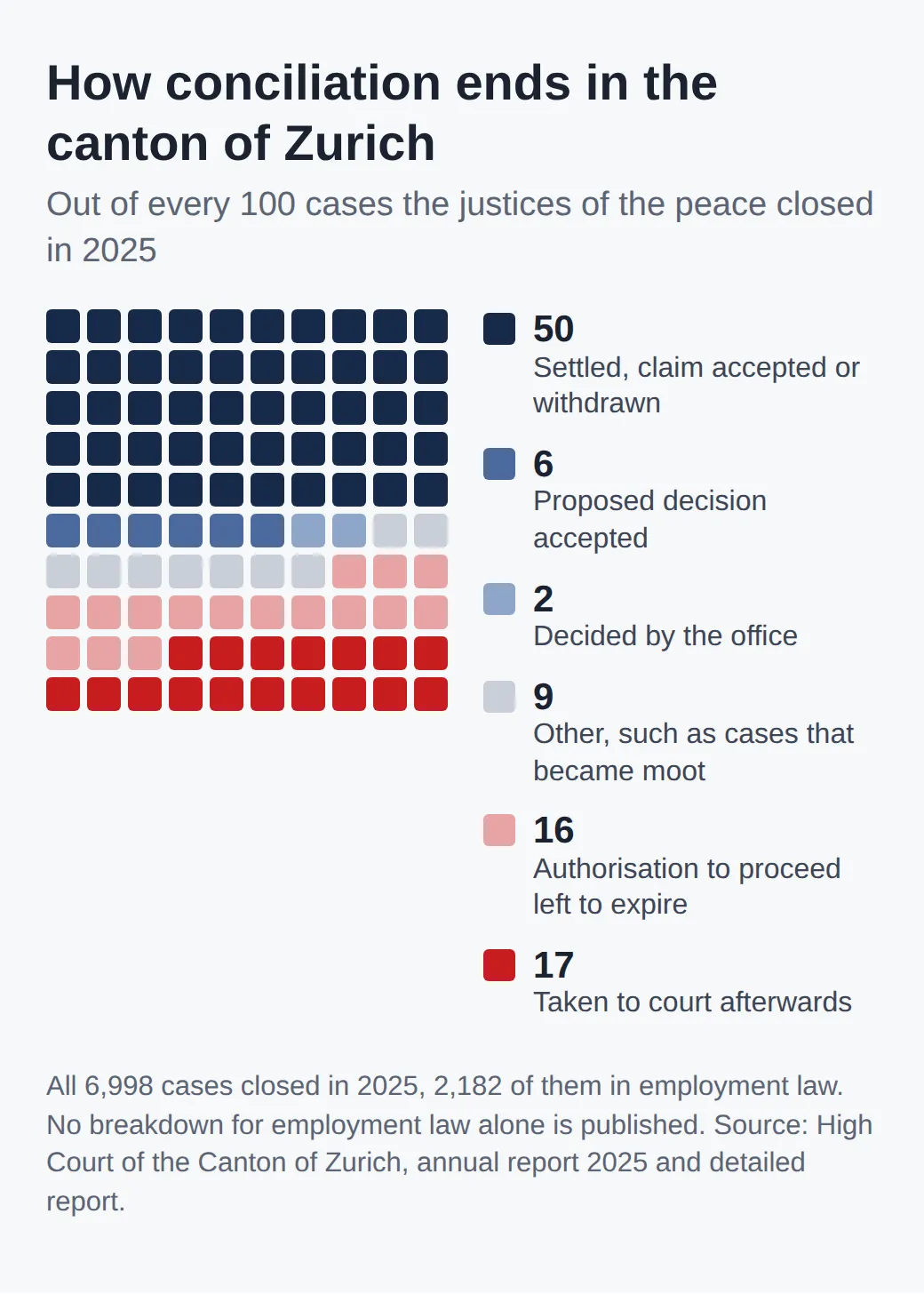
Only 17 in 100 cases went on to court. These figures cover all areas of law together; the High Court doesn't publish a separate breakdown for employment law. For your preparation, the lesson still holds: come with a figure you'd accept. A settlement before the justice of the peace is final, and if you hold out for more, you carry the risk of the next stage. What that risk costs depends almost entirely on one number.
How much does a labour court case cost?
Up to a value in dispute of CHF 30,000, neither the justice of the peace nor the labour court charges court costs (Art. 113 and 114 CPC). That's the part almost everyone knows. The Zurich courts point out the catch themselves on their page about legal costs (in German): free only means the court charges nothing for its own work. If you lose, you still have to pay the other side's party costs, in other words their lawyer's fees. Only in conciliation proceedings are no party costs awarded.
How much they come to is set by Zurich's ordinance on lawyers' fees (in German). At a value in dispute of CHF 20,000, the base fee is CHF 3,900; at CHF 30,000, it's CHF 5,000. Above CHF 30,000 the court fee comes on top, which under the High Court's fee ordinance (in German) is CHF 3,150 plus 8 percent of whatever is above CHF 20,000. At CHF 40,000, that's CHF 4,750. The court can go above or below both amounts depending on the work involved and how difficult the case is, and your own lawyer's costs come on top if you hire one.
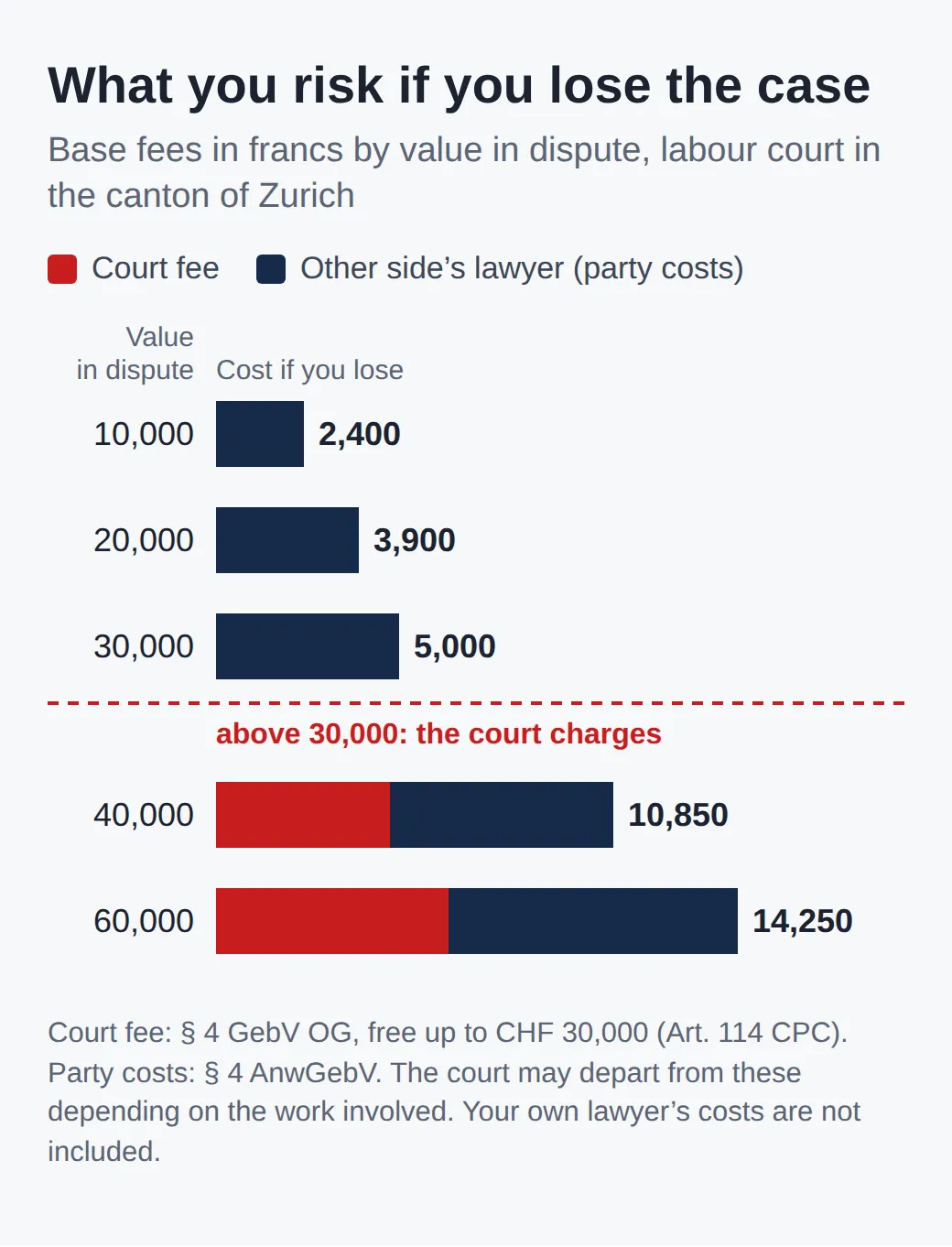
The chart shows the edge. Between a value in dispute of CHF 30,000 and CHF 40,000, the risk more than doubles, from CHF 5,000 to CHF 10,850. If your value in dispute is just above the limit, it can pay to claim only the part you can prove well. Above CHF 30,000, the court can also ask you for an advance on costs.
If you can't afford this, apply for legal aid, provided your case isn't hopeless (Art. 117 CPC). It covers the court costs and, if needed, a lawyer paid by the canton. But there's one thing it doesn't protect you from: if you lose, you still owe the other side its party costs (Art. 118 CPC). The application goes to the district court, and the courts have an information sheet on it. With the costs in mind, you can weigh up the next stage.
Filing your claim with the district's labour court
Once you have the authorisation to proceed, you have three months to file your claim with the court (Art. 209 CPC). The City of Zurich says 90 days on its page. The three months in the law are what count, and depending on the month the two ways of counting are one or two days apart. So don't wait until the last day. There's no single labour court for the whole canton: each of the twelve district courts acts as the labour court for disputes arising from employment (§ 20 GOG). The labour court for the city of Zurich is part of the District Court at Wengistrasse 30 in district 4.
Up to CHF 30,000, the presiding judge decides alone. From CHF 15,000, you can ask for the case to go before the full court, where one representative of employers and one of employees also decide (§ 25 GOG). Above CHF 30,000, the full court always hears the case.
Up to CHF 30,000, the simplified procedure applies (Art. 243 CPC), and it's designed for people without legal training. Your claim only has to name the parties, what you're asking for and what the dispute is about; you don't need to include a statement of grounds (Art. 244 CPC). You enclose the authorisation to proceed and your documents. The court asks if something is missing and, in employment cases up to CHF 30,000, establishes the facts itself (Art. 247 CPC). So you don't need to be a lawyer. You still need evidence, though: no record of your hours, no overtime.
A lawyer can represent you. In the simplified procedure, according to the Zurich courts, an employee of an employees' association you belong to can represent you too, your trade union for example. The judgment often arrives first without written reasons. Ask for them within ten days, or you give up your right to appeal (Art. 239 CPC). You then file the appeal with the High Court within 30 days of receiving the reasons, but only if your final claims before the labour court were worth at least CHF 10,000 (Art. 308 and 311 CPC). Few cases get that far. Far more often, a claim fails because of a deadline that ran out long before.
The deadlines that wipe out your claim
The strictest deadline applies to unfair dismissal, for example if you're dismissed because you asked for your pay. There are two deadlines here, and if you miss either one, you lose the compensation of up to six months' salary entirely (Art. 336a and 336b CO). Your written objection must reach your employer before the notice period ends. After that, you must bring your claim within 180 days of the job ending. The application for conciliation at the justice of the peace already counts as bringing a claim (Art. 62 and 64 CPC), and according to the Zurich courts it's enough to post it on the last day.
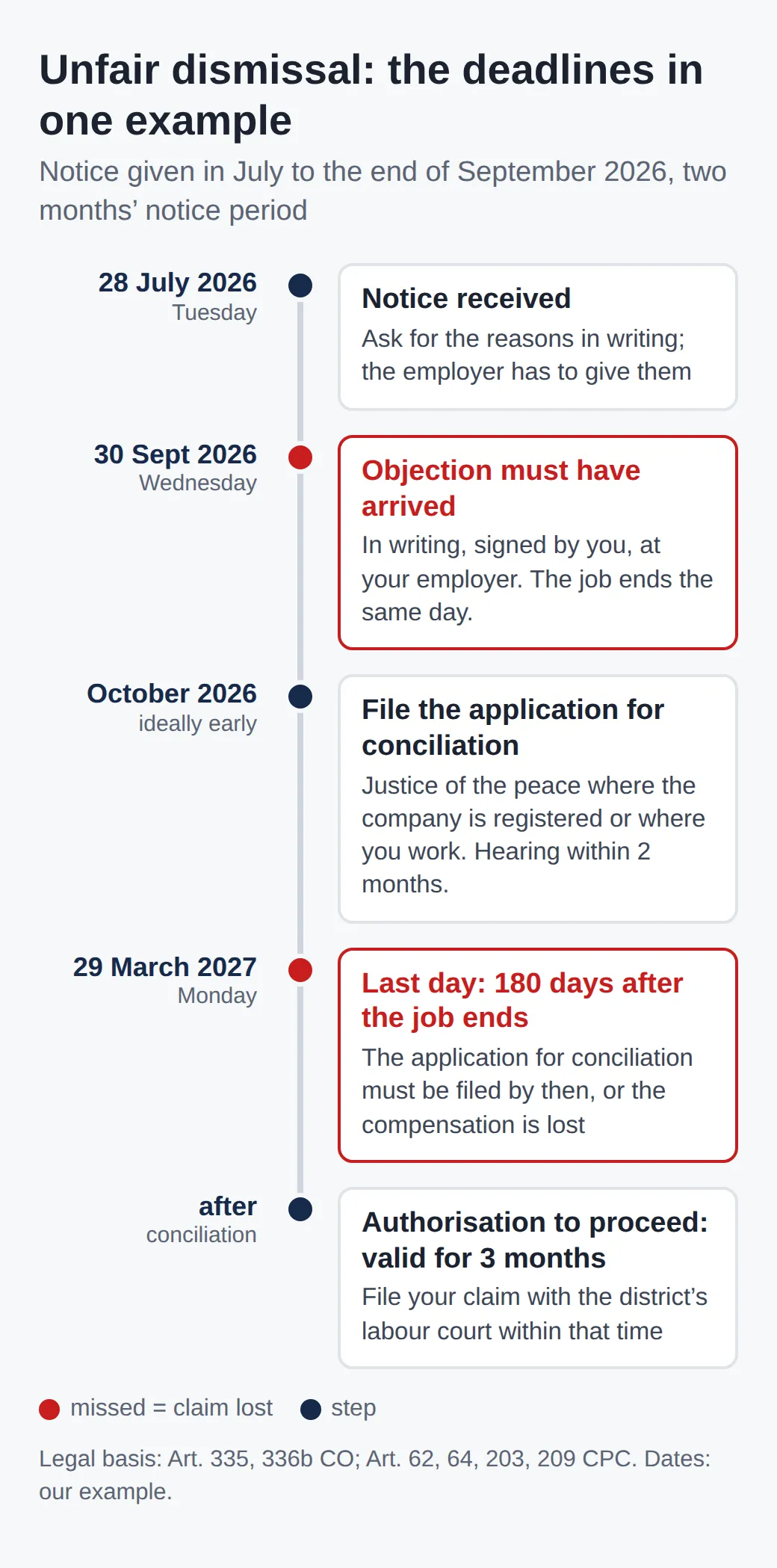
Count the 180 days from the day after your job ends. If it ends on 30 September 2026, the last day is 29 March 2027. Don't count on court holidays: the pause in deadlines over Easter, in summer and over Christmas doesn't apply to conciliation proceedings (Art. 145 CPC).
You have more time for unpaid wages. Claims from employment become time-barred after five years (Art. 128 CO). Watch out for settlement clauses: while you're employed and for one month after the job ends, you can't validly waive claims that the law or a collective labour agreement makes mandatory (Art. 341 CO). So signing a line saying “all claims have been settled” shortly before you leave doesn't always bind you.
The deadline is short if the company goes bankrupt. You must apply to the unemployment insurance fund of the canton where the company is registered for insolvency compensation no later than 60 days after the bankruptcy is published. It covers at most the four months before your last working day and earnings of up to CHF 12,350 a month, according to the canton (in German). In Zurich, you can get advice on all of this for free.
Free advice in Zurich
The Zurich labour court offers free legal information (in German) if you work or live in the city or your employer is registered there. You can drop in at Wengistrasse 30 on Mondays from 8.30 to 11 am and on Wednesdays from 1.30 to 4 pm, or call 058 111 60 06 on Monday afternoons, Wednesday mornings and Fridays. You can't book in advance. Each conversation lasts about 15 minutes, is in German only, and is only available as long as no proceedings are under way. The court explains the law and the procedure, but doesn't assess your chances in court or fill in forms for you. Bring your contract, payslips and letters.
The other district courts have their own services; Winterthur's, for instance, is by phone on Wednesdays from 2 to 4 pm. An overview by district is on the Zurich courts' page (in German). Other options:
- the free legal advice of the Zurich Bar Association and the City of Zurich at Strassburgstrasse 9, a 15-minute talk with a lawyer, in the evening from Monday to Thursday, with same-day appointments
- the church-run advice centre DFA (in German), with free legal advice on employment law and unemployment insurance
- impuls (in German), with a free short consultation for people who live in the city of Zurich
- your trade union or another employees' association, if you're a member, since their staff can also represent you in the simplified procedure
If you work for the city or the canton, contact the ombudsman's office of the city or the canton (both in German). The list of these services comes from the District Court of Zurich itself.
What to do now
Start a folder before you write a single letter: your contract, payslips, the dismissal with the date it reached you, emails and a list of your hours. Then work out your deadlines and put them in your calendar, starting with the end of your notice period if you've been dismissed. After that, demand in writing what you're owed and set a short deadline.
If nothing comes, your application for conciliation goes to the justice of the peace where the company is registered or where you work. Up to CHF 30,000 it costs you nothing, and across all areas of law, half the cases end there with a settlement, an acceptance or a withdrawal. If you're unsure whether the step is worth it, call the court's legal information service first. And if you're already looking for a new job, our post on salaries in Zurich has the figures to put your next offer in context.
Common questions
- Can my employer fire me for asking to be paid?
- A dismissal like that is unfair in the legal sense if you assert claims from your employment in good faith (Art. 336 para. 1 let. d CO). It can't be reversed; instead, the law provides for compensation of up to six months' salary (Art. 336a CO). The same deadlines apply as for any unfair dismissal: a written objection before the notice period ends, and a claim within 180 days.
- I don't speak much German. Can I still go to the justice of the peace?
- Yes. On the City of Zurich's form, you tick whether you need an interpreter and name the language. The free legal information service at the District Court of Zurich, on the other hand, is only available in German. It's best to take someone along who can interpret for you.
- I work for the city or canton of Zurich. Does this process apply to me?
- Usually not. If you were appointed by a formal ruling, your employment is governed by public law, and neither the labour court nor its legal information service deals with it. Your first port of call is the ombudsman's office of the city or the canton, which is free for employees. One exception is discrimination based on sex: the conciliation authority under the Gender Equality Act also handles cases from city and canton employees.
- Do I have to start debt collection against my employer first?
- No, you don't need debt collection proceedings to apply for conciliation. If you've already started them, enclose a copy of the payment order. If the company is insolvent, though, pursuing debt collection up to the seizure stage is one of the ways to qualify for insolvency compensation from the unemployment insurance fund.
More posts
All posts
Zurich Job Market 2026: Unemployment, Jobs, Skills Shortage
Zurich's job market in autumn 2026: 2.9 percent unemployment, more vacancies, which jobs are in demand and what is left of the skills shortage.

Minimum Wage in Zürich: CHF 23.90, Who Gets It and When
Zürich's minimum wage is CHF 23.90 an hour, Winterthur's CHF 23. What the Federal Supreme Court ruled, who gets it, the exceptions and when it starts.

Daycare Costs in Zurich 2026: Fees, Subsidies, Tax Deduction
Subsidised daycare (Kita) in Zurich costs CHF 12 to 120 a day in 2026. How the city sets your fee, what you can deduct and what an extra workday costs.