Daycare Costs in Zurich 2026: Fees, Subsidies, Tax Deduction

What parents pay
A full day at a daycare centre (Kita) costs parents in the City of Zurich between CHF 12 and 120 in 2026, as long as the city subsidises the place. Where you land in that range depends on your taxable income and assets. Without a subsidy, each daycare sets its own price, for example CHF 130 at the universities' kihz centres for children from 18 months, and CHF 150 at the University Hospital's daycare for families who don't work there.
How many days the city helps pay for depends on how much both parents work in total. So the daycare fee is part of every job decision: if you go from 60 to 80 percent, you need one more day of care, and later you pay a higher fee on every day. We work this through with the city's own rules, explain the tax deduction and show what after-school care costs once your child starts kindergarten. The figures apply to families living in the City of Zurich; what changes if you live in another municipality is covered further down. The city's pages and forms are in German only.
What a daycare place costs in Zurich
A day at daycare costs more than parents see on the invoice. For a subsidised place, the city pays a private daycare on the basis of a standard cost rate of CHF 139.35 a day. That figure is in the annex to the city's ordinance on childcare outside the family, known as the VO KB, and has applied since January 2026. The rate assumes 11.5 opening hours a day and 240 opening days a year. Parents pay at least CHF 12 and at most CHF 120 of it, and the city covers the rest. For babies up to 18 months, it pays the daycare an extra CHF 53.20 a day. Your own fee stays the same.
Without a subsidy, daycares are free to set their prices. Two price lists for 2026 show where those sit. The kihz daycare centres, run by a foundation funded by ETH Zurich, the University of Zurich, Empa and Eawag, charge CHF 130 for a full day from 18 months and CHF 180 for younger children. The University Hospital's daycare (Kita USZ) charges families without a job at the hospital CHF 150 a day, which comes to CHF 1,890 a month for three days a week. In 2022 the cantonal government gave a ballpark figure for a whole year: in its media release, it put the cost of a full-time, unsubsidised daycare place in the canton at CHF 25,000.
The city's open data shows how big the market is. At the end of 2025 there were 321 licensed daycares with 11,772 places. 298 of them are private daycares with a contract with the city, which means they may offer subsidised places, plus 10 run by the city itself. 3,383 subsidised places were taken. The city estimates the turnover of all daycares and childminders in 2025 at CHF 327.5 million, of which CHF 231 million came from parents' fees. So families pay roughly seven out of every ten francs themselves. How much of that falls on you comes down to two numbers: your contribution factor and the number of days the city subsidises.
How the city works out your fee
Your fee is the minimum of CHF 12 plus a share of the gap to the maximum fee, which is CHF 108. The size of that share is your contribution factor (Beitragsfaktor). To get it, the city takes the taxable income from your latest final tax assessment, adds 10 percent of any assets above CHF 50,000 per parent, and deducts CHF 6,000 for the household and CHF 6,000 for each person in it. The result is called the assessable amount (massgebender Betrag). Divided by 100,000, it gives the contribution factor. For a married couple with one child, the example we use throughout this post, it looks like this:
- joint taxable income: CHF 90,000
- taxable assets of CHF 60,000: below the allowance of CHF 100,000 for two parents, so they don't count
- deductions for the household, two parents and one child: 4 × 6,000 = CHF 24,000
- assessable amount CHF 66,000, contribution factor 66 percent
- fee per day: 12 + 108 × 0.66 = CHF 83.28
You don't have to work this out by hand. The city's contribution calculator shows every step once you enter your income, assets and the number of people in your household.
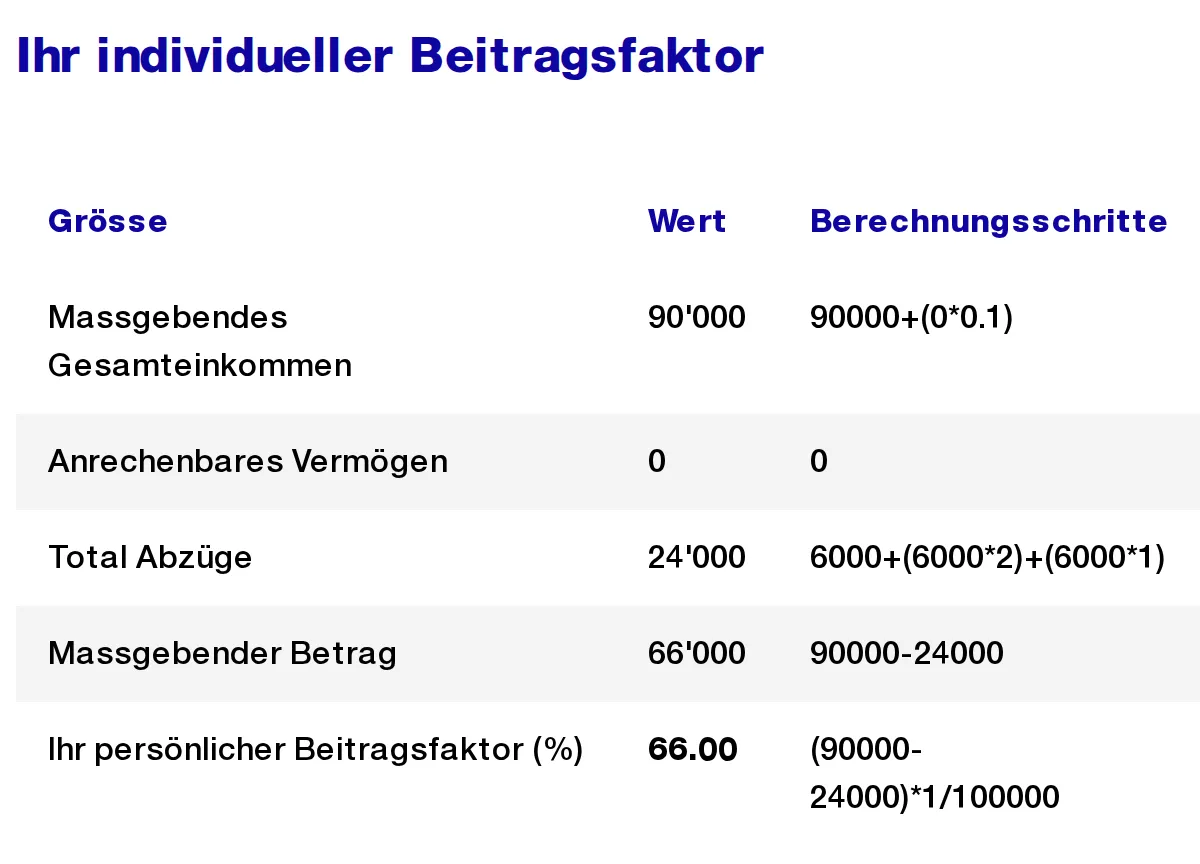
The city counts a month as four weeks. Three days of daycare a week therefore cost our family CHF 999.35 a month, or around CHF 12,000 a year. The calculator gives exactly that amount. The city's own examples follow the same formula, using a family with two children.
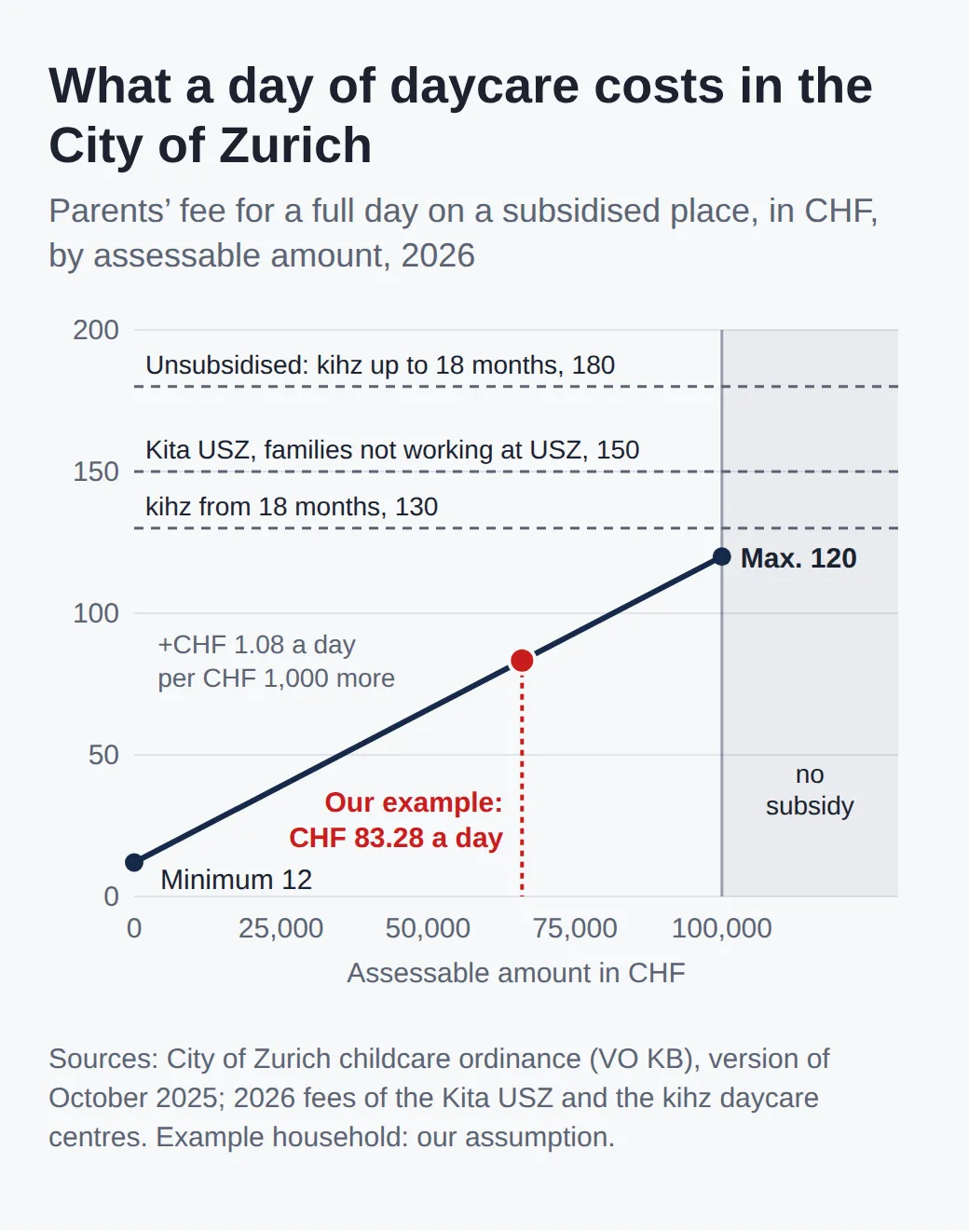
The formula gives you a simple rule: every CHF 1,000 more in assessable amount costs CHF 1.08 more per day of daycare. Over 48 weeks, that's CHF 51.84 a year for each weekday your child spends at daycare. With four days a week, almost 21 centimes of every extra franc of taxable income goes to the daycare, on top of the tax. That holds up to the limit of CHF 100,000. Beyond it there's no subsidy at all: at a private daycare you then pay its own price, CHF 130 to 180 at the two daycares above.
Two details decide when a change in salary feeds through. The city goes by your latest final tax assessment, and you confirm that your income and assets today don't differ from it by more than 20 percent. If the gap is bigger, the city uses your current documents. The factor is valid for one year at a time. If you pay withholding tax, you have no tax assessment, so under Art. 11 VO KB you submit current proof of income and assets instead. The factor alone doesn't pay for a single day, though. For that you need the second confirmation.
How many days of daycare the city pays for
The city subsidises as many days as both parents together work above 100 percent. Every 20 percent gives one day, rounded up to whole days, as the city's worked examples show. Single parents don't subtract 100 percent. Besides paid work, training, looking for a job and volunteering also count. The city calls this entitlement the subsidised scope of care (subventionsberechtigter Betreuungsumfang, SBU).
| Workload parent A + B | Above 100 percent | Subsidised days |
|---|---|---|
| 100 + 40 | 40 | 2 |
| 100 + 50 | 50 | 3 (rounded up) |
| 100 + 60 | 60 | 3 |
| 100 + 80 | 80 | 4 |
| 80 + 80 | 60 | 3 |
| single parent 60 | 60 | 3 |
Two rows are worth a second look. If you work 50 rather than 60 percent, you still get three days, because the city rounds up. And if one parent cuts from 100 to 80 percent while the other goes up from 60 to 80, it stays at three days. Shifting hours between the two of you doesn't change the number of subsidised days.
The two confirmations come from two different departments. The Social Services Department issues the SBU, and the School and Sports Department issues the contribution factor; both are linked on the page on costs and subsidies. Apply for them before your daycare contract starts. Until both are valid, the daycare may charge you the full price, and according to the city's answers to common questions, it generally doesn't pay subsidies retroactively. For days beyond your SBU you pay the daycare's unsubsidised price, and for opening hours beyond 11.5 hours a day or more than 240 days a year it may charge extra. No private daycare is obliged to offer you a subsidised place, either, so ask before you sign. An example shows how all of this plays out when you change your workload.
Part-time or full-time: what one more day costs
With a child at daycare, far less of any extra pay stays with you than your salary certificate suggests. Take our family with a contribution factor of 66 percent. Parent B works 60 percent on a full-time salary of CHF 90,000 and goes up to 80 percent. That brings in CHF 18,000 more gross pay a year. Of that, 5.3 percent goes to AHV, IV and EO (old-age, disability and income compensation insurance) and 1.1 percent to unemployment insurance (ALV), CHF 1,152 together, as the leaflets on AHV contributions and on unemployment insurance (in German) show.
The fourth day of daycare costs CHF 83.28 times 48 weeks, so CHF 3,997. A second bill comes later: as soon as your tax assessment shows the higher salary, your contribution factor goes up. In our example, taxable income rises by around CHF 13,650, because we only subtract the social security contributions and the tax deduction for the new daycare day, 80 percent of which counts (more on that in the next section). The factor then rises to 79.65 percent and the fee to CHF 98.02 a day. Across four days, that's CHF 2,830 more a year.
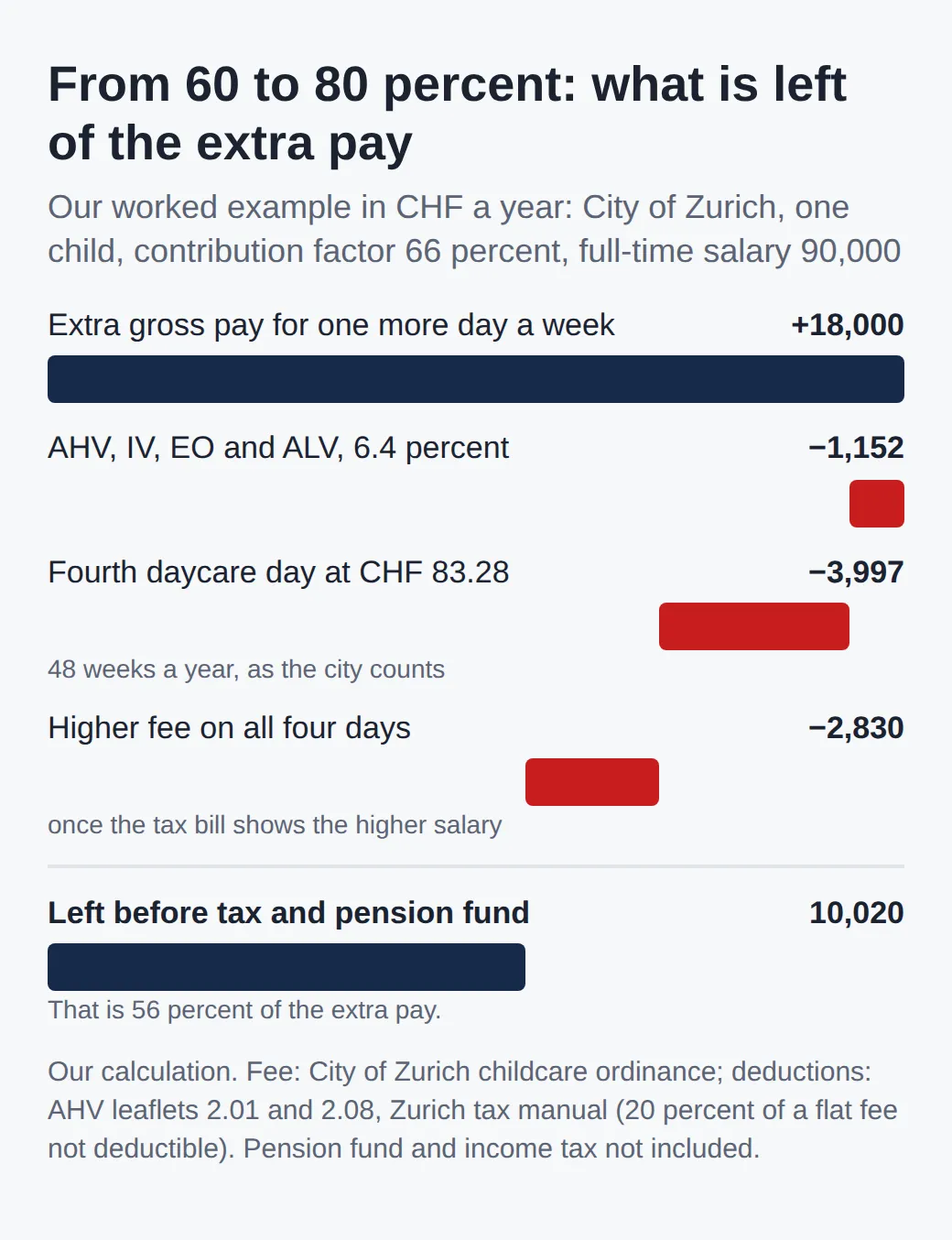
That leaves CHF 10,020, or 56 percent of the extra pay, and income tax and pension fund contributions still come off that. A fifth day costs more again: at the higher factor it's already CHF 4,705 a year, and with the next pay step the factor moves close to the 100 percent limit. With two children at daycare, the daycare items in this calculation almost double, while the salary stays the same.
None of this means work doesn't pay. The calculation leaves out what a bigger workload brings in the long run: pension fund contributions, experience and better chances at your next job. And from kindergarten onwards, childcare costs drop a lot. What it does show is why parents with a child at daycare need to read a salary offer differently: compare what's left after daycare, not the gross figure. To see how your salary compares, read our post on salaries in Zurich. Part of your daycare costs comes back through your taxes.
What you can deduct from your taxes
You can deduct what you pay for daycare, after-school care and childminders as childcare costs. In the 2025 tax return, which you fill in during 2026, the guide to the 2025 tax return (in German) sets the maximum per child at CHF 25,000 for cantonal and municipal tax and CHF 25,800 for federal tax. For the 2026 tax year, the cantonal amount goes up to CHF 25,300, according to the 2026 guide. Your child must be under 14 and live with you, and the care must be needed because of work, training or inability to work. Married couples can only claim the deduction if both work, are in training or are unable to work. Unmarried parents with joint custody in the same household can each deduct half; any other split has to be backed up with proof.
The detailed rules are in the directive on social deductions in the Zurich tax manual (Steuerbuch), which applies from 2026, and one of them is easy to miss. If your daycare only charges a flat fee, 20 percent of it counts as living costs, for meals for example, and can't be deducted. If the share for food and care at your daycare is smaller, you can prove it, so ask for a breakdown. You can also only deduct what you paid yourself. The city pays its share straight to the daycare, and that share doesn't belong in your tax return. Enclose a list of your payments with the names of the recipients. The Kita USZ, for example, sends a confirmation of the fees paid by the end of February.
The deduction works twice. It lowers your tax, and because the city calculates your contribution factor from your taxable income, it later lowers your daycare fee as well. In our example, the deductible part of the fourth daycare day, CHF 3,198, makes the fee CHF 3.45 a day cheaper. How much tax a deduction saves depends on your income and your municipality. We show how to work it out using the commuting deduction as an example.
If you pay withholding tax, the rates include the childcare deduction only at a flat amount or not at all. You can claim your actual costs through a subsequent ordinary assessment. The request must reach the tax office by 31 March of the following year, and that deadline can't be extended. Once your child starts kindergarten, the sums change anyway.
After-school care and day schools: cheaper from kindergarten
Daycares look after children until kindergarten, and after that the school takes over. Care is organised by the city's school office, and unlike at daycare, children here are entitled to a place under the VO KB. The same contribution factor applies, and you're charged per booked module. The fees are set out in the terms and conditions for school-based care, which the school board adopted in March 2026 and which have applied since the 2026/27 school year. In CHF, for our family with a factor of 66 percent:
| Service | Minimum | Maximum | At 66 percent |
|---|---|---|---|
| Lunch, booked freely | 4.50 | 18.00 | 13.41 |
| Afternoon module 1, until 3.30 or 4 pm | 2.00 | 20.00 | 13.88 |
| Afternoon module 2, then until 6 pm | 2.00 | 20.00 | 13.88 |
| Full day in the school holidays | 10.00 | 105.00 | 72.70 |
A school day with lunch and both afternoon modules until 6 pm therefore costs the family CHF 41.17, half the price of a daycare day. Morning care costs CHF 3 for everyone. At day schools (Tagesschulen), lunch is built in on certain days at a flat fee of CHF 6: twice a week in the second year of kindergarten, three times in years 1 to 4, and four times from year 5. The school holidays remain the expensive part. Four weeks of holiday care cost 20 × 72.70 = CHF 1,454 at a factor of 66 percent. You have to book holiday care at least 30 days before the first day of the holidays, and after that the booking is binding.
After-school and holiday care count towards the tax deduction too, but trips, meals and entrance fees during the holidays don't. If you still have children of daycare age, it's also worth asking your employer.
Employers with their own daycare
Some large employers in Zurich run their own daycares or contribute to the cost. In 2026 the University Hospital charges its staff CHF 120 a day instead of 150, the same for babies and older children. The amount is deducted straight from your salary. If you live in the city, you can also apply for the city's subsidies on top. At the kihz daycares, students and staff of ETH Zurich, the University of Zurich, Empa and Eawag get priority. Their institution covers the surcharge for babies up to 18 months, and if you live outside the city, you can apply to it for subsidies, calculated under the city's ordinance.
For a family with a baby, that makes a big difference: CHF 180 rather than 130 a day without a subsidy, or around CHF 7,200 a year for three days a week. So ask about daycare places and contributions at your job interview, especially at hospitals, universities and in public administration. To see which employers in Zurich have the most staff, read our overview of the largest employers. An employer can cushion a lot, but it can't change where you live.
If you live outside the City of Zurich
The city's subsidies only apply to children who live in the city. For children living in another municipality, city-run facilities charge the maximum fee (Art. 17 VO KB). There's one exception: if your child regularly lives with a parent in the city on certain weekdays, the city charges the normal fee for those days. So if you live in Winterthur, Uster or Thalwil and choose a daycare near your workplace in Zurich, you need to contact your own municipality. Most municipalities subsidise daycare, but each under its own rules. The University Hospital points this out explicitly in its regulations.
So far there is no cantonal model. In March 2025 the cantonal government rejected cantonal co-funding, arguing that care for young children is a matter for the municipalities. Something uniform is coming from the federal government instead, but not for a few years.
The federal childcare allowance comes later
The new federal childcare act, known as the UKibeG, brings a childcare allowance for working parents. According to the Federal Social Insurance Office (in German), it will be at least CHF 100 a month for one day of care a week and CHF 50 for each additional half day, until the end of the month in which the child turns 8. It applies to daycares and childminders working through an organisation, not to nannies or grandparents, and as a rule only if both parents work or are in training.
No referendum was launched; the deadline expired on 2 July 2026. As of the end of September 2026, the office's page still gives no date for the act to come into force. The industry association kibesuisse, in its media release of July 2026, expects it on 1 January 2029 at the earliest. So for your budget over the next two years, the allowance doesn't count yet.
What to sort out before your next job
Work out your contribution factor with the city's calculator before you negotiate your workload. With the factor, you know what one day more or less of daycare costs, and you can see whether a bigger workload takes you over a 20 percent threshold that brings another subsidised day. Apply for your contribution factor and SBU as soon as a daycare offers you a place, because until both confirmations arrive, you pay the full price.
Ask your daycare for an invoice that lists care and meals separately; it helps with the tax deduction. And read job offers with the daycare bill in mind: in our example, CHF 18,000 more gross pay was worth just over CHF 10,000 before tax. If you're looking right now, filter our part-time jobs for a workload that fits your daycare week.
Common questions
- Is there a settling-in fee at a daycare in Zurich?
- Not on a subsidised place. According to the City of Zurich's answers to common questions, the subsidised parents' fee applies from the first day, and there is no separate charge for the settling-in period. A daycare may only ask for a registration fee if it pays it back with the first invoice, and it must return a deposit in full at the end.
- Do I still have to pay for daycare when my child is sick or on holiday?
- Yes. The city's ordinance states that your fee does not drop when your child misses an agreed day, whatever the reason. The city subsidises voluntary absences such as holidays for seven weeks at most. If your child stays away longer, the daycare can charge you the full price.
- Do I need a separate subsidy application for each child?
- No. One contribution factor and one confirmation of your subsidised days cover all the children in the same household. Each child also lowers the assessable amount by CHF 6,000, which cuts the fee by CHF 6.48 a day for every child in the family.
- Can I get help paying for a childminder or a nanny in Zurich?
- The city subsidises childminders (Tagesfamilien) by the hour, and the parents' fee in 2026 is between CHF 1.10 and 8.80. For tax, you can also deduct a carer you employ yourself, but you then enclose a copy of their salary certificate. The future federal childcare allowance, however, will not cover nannies or grandparents.
More posts
All posts
Average Salary in Zürich? The Median by Industry, 2024
Median salary in Zürich in 2024: CHF 8,508 a month in the city, CHF 7,502 in the canton. By industry, age and gender, with gross and net explained.

Zürich Commuting Tax Deduction 2026: Travelcard, Bike, Car
Commuting deduction in Zürich 2026: up to CHF 5,200 cantonal, CHF 3,300 federal. ZVV prices, bike, car at CHF 0.75 per km and what you really save.

Minimum Wage in Zürich: CHF 23.90, Who Gets It and When
Zürich's minimum wage is CHF 23.90 an hour, Winterthur's CHF 23. What the Federal Supreme Court ruled, who gets it, the exceptions and when it starts.