Withholding Tax in Zürich 2026: Rates, Deductions, Refunds
The essentials first
In the canton of Zürich you pay withholding tax if you live here, have neither a C permit nor a Swiss passport, and aren't married to someone who does. Your employer deducts it from your gross salary every month: in 2026, 8.24% on CHF 7,500 for a single person without children or church tax. From CHF 120,000 a year a tax return follows automatically; below that, you can apply for one by 31 March of the following year.
There's more behind those percentages than your payslip shows. Using the Cantonal Tax Office's own documents, we show what the tariff already deducts for you, why your municipality and the month with your 13th salary shift the deduction, and how to decide whether a subsequent ordinary assessment is worth it. Once you have applied for one, you can't withdraw it. In German, withholding tax is Quellensteuer, and that's the word on your payslip.
Who pays withholding tax in Zürich
You pay withholding tax if you live in the canton, work for an employer based in Switzerland and hold neither a C permit nor a Swiss passport. That's how the canton's page on who is liable for withholding tax puts it; like all of the canton's tax pages it is in German, while its welcome page for newcomers covers the basics in English. The main exception is for couples: if you are married or in a registered partnership with someone who has a C permit or a Swiss passport, you don't pay withholding tax but file a normal tax return like everyone else.
You can also be affected if you live abroad, as soon as your employer is based in the canton of Zürich. That applies to cross-border commuters, to weekly residents, to employees in international transport and to a few special cases such as directors' fees. Cross-border commuters from Germany who return home every day pay a fixed rate of 4.5%.
Withholding tax ends from the month after one of these events: you get a C permit or a Swiss passport, you marry someone with a C permit or Swiss passport, or you start drawing the AHV old-age pension or a full IV disability pension. After a C permit or a marriage you file a normal tax return for the whole year, and the withholding tax already deducted is credited, without interest. The reverse also holds: if you separate from or divorce such a person, withholding tax starts again the month after.
2026 tariffs: what A0N, B2Y and C1N mean
Your tariff is made up of a letter, a number and a Y or N. The letter stands for your situation, the number for the children you get a deduction for, and the last letter for church tax. The canton's tariff page explains the codes and has a tariff calculator. The letters that matter most:
- A for single people: unmarried, separated, divorced or widowed
- B for married people whose partner has no earned income
- C for married couples where both earn
- H for single people who live with their children and mainly support them
- G for replacement income such as daily allowances paid directly by an insurer
Children who count are minors in your care or custody and adult children in their first education or training whom you mainly support, even if they live abroad. Y means you belong to one of Zürich's three recognised churches: Swiss Reformed, Roman Catholic or Christian Catholic. If you don't give your employer reliable details, the 2026 information sheet says it must use A0Y, or C0Y if you're married. That's usually the more expensive tariff.
The percentage applies to your whole gross salary for the month, including allowances such as family allowances. These are the rates in the 2026 tariff tables, each without church tax and without children:
| Gross salary per month | A0N, single | B0N, single earner | C0N, dual earners |
|---|---|---|---|
| CHF 5,000 | 5.52% | 3.01% | 6.41% |
| CHF 7,500 | 8.24% | 5.43% | 8.89% |
| CHF 10,000 | 10.59% | 7.52% | 10.48% |
| CHF 12,500 | 12.91% | 9.54% | 12.49% |
At CHF 7,500, children pull the rate down a lot: with two children, tariff B drops from 5.43% to 2.12%. Church tax makes little difference by comparison; in tariff A the rate on that salary rises to 8.45%, about CHF 16 a month more. For comparison, the canton's 2024 median salary is CHF 7,502, which we explain in our post on salaries in Zürich. Single and without church tax, you'd pay 8.29% on it, about CHF 622 a month.
Tariff C contains an assumption. Your employer doesn't know your partner's salary, so the tariff builds a standard figure for it into the rate: at most CHF 5,875 a month, according to the canton's 2026 calculation parameters. If your partner earns much more, your deduction tends to be too low; if they earn little, too high. The only place this evens out is a tax return.
What the tariff already deducts for you
The tariff isn't a rough surcharge. It's a tax return worked out in advance with standard deductions, and the tax office lists them in its basis and calculation parameters for 2026. For cantonal and municipal tax, these are among the amounts built in:
- social security contributions from your salary: 5.3% for AHV, IV and EO (old-age, disability and income compensation), 1.1% unemployment insurance, 1% non-occupational accident insurance and 6.5% pension fund
- insurance premiums of CHF 2,900 for single people, CHF 5,800 for married couples and CHF 1,300 per child
- work expenses: CHF 1,400 for travel, CHF 3,200 for meals away from home and a flat 3% of your salary, at least CHF 2,000 and at most CHF 4,000
- a child deduction of CHF 9,400 per child
What's missing is everything that varies from person to person. The page on the subsequent ordinary assessment gives examples: payments into pillar 3a, buy-ins to your pension fund, further training you pay yourself up to CHF 12,000 a year, childcare by third parties, maintenance payments, interest on debts and costs due to illness or disability. On top of that come donations and actual work expenses above the flat rates, such as a long commute.
So if you pay the maximum into pillar 3a every year or pay for a daycare place, the tariff makes you pay too much, because those deductions aren't in it. One figure in the same document is even less well known: the tax multiplier.
Where you live counts, but the tariff ignores it
The withholding tax tariff is the same across the canton, whether you live in Zumikon or in Winterthur. To manage that, it uses averages. According to the 2026 calculation parameters, these are a cantonal tax multiplier of 98% and a weighted average of the municipal multipliers of 109.90%, or 116.00% with church tax. The tax multiplier, Steuerfuss in German, is the factor by which the canton and the municipality multiply what's called the basic cantonal tax. In total, the tariff assumes 207.9%.
The actual figures are different. The Cantonal Council set the cantonal tax multiplier for 2026 and 2027 at 95%, down from 98% in the two years before. And according to the Statistical Office's data, the municipalities range in 2026 from 71% in Zumikon to 128% in Bachs and Maschwanden. The city of Zürich charges 119%, Winterthur 125%, Küsnacht 73%.
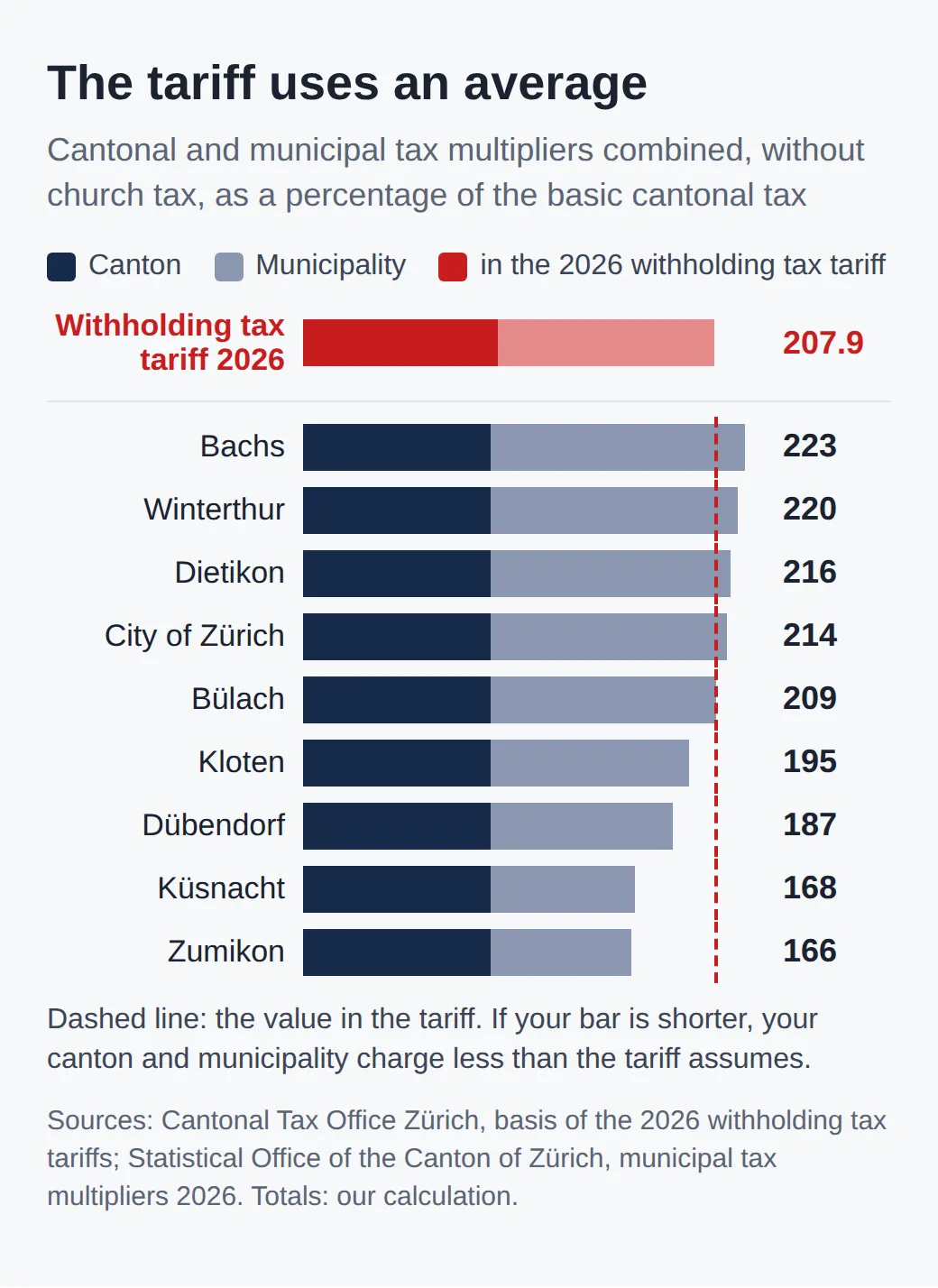
For the withholding tax itself this makes no difference; it stays the same for everyone. It only counts once you file a tax return. Then the tax office uses your municipality's multiplier, as it does for everyone else. In Küsnacht or Zumikon that multiplier is well below the figure in the tariff; in the city of Zürich it's slightly above it, and in Winterthur clearly above. The multiplier only affects cantonal and municipal tax, though, not federal tax, and your deductions often matter more. It's one factor among several.
The expensive December: 13th salary and bonus
In the canton of Zürich, each month is a tax period of its own, and there's no adjustment at the end of the year. That's what the tax office's information sheet says. It has a consequence many people only notice on their payslip: if your employer pays the 13th salary in December, your gross salary doubles that month, and the percentage rises with it.
We worked it through with tariff A0N for 2026. At CHF 7,000 gross a month the rate is 7.75%, or CHF 542.50. In December you get CHF 14,000, which is taxed at 14.27%: CHF 1,997.80. Over the year that adds up to CHF 7,965.30. If the same annual salary of CHF 91,000 were paid in twelve equal parts, it would be 8.32% on CHF 7,583, or CHF 7,571.20 in total. The difference is CHF 394.
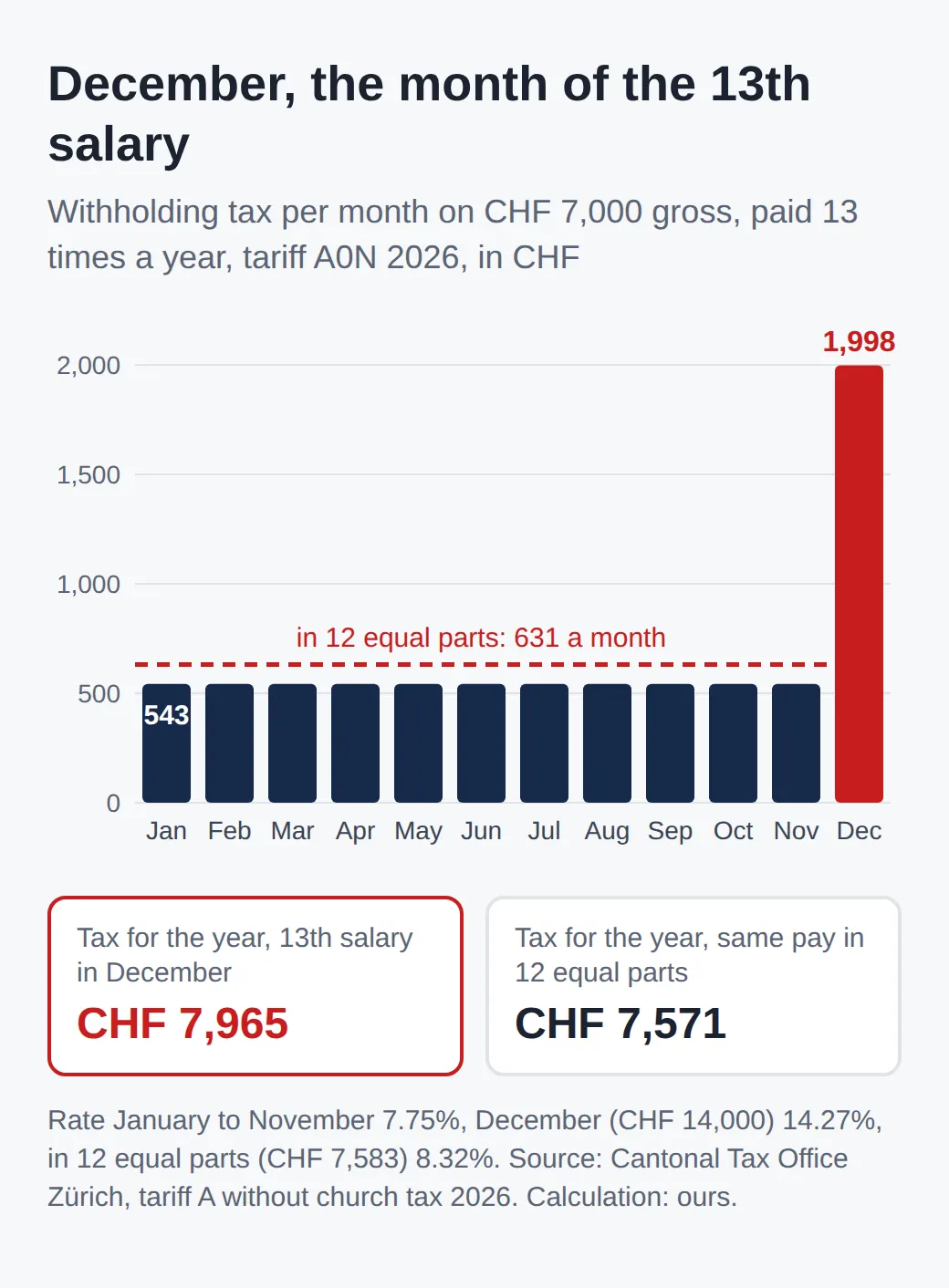
A bonus works the same way: it counts towards the salary of the month it's paid in. The only exception is when your employment contract pays the 13th salary in monthly instalments; then there's no December spike. Withholding tax never corrects this itself, because it's calculated correctly. Only in a tax return does your income count as a year's total.
The subsequent ordinary assessment (NOV)
With a subsequent ordinary assessment, nachträgliche ordentliche Veranlagung or NOV in German, you file a normal tax return after the end of the year. The tax office then calculates your tax as it does for everyone else and credits the withholding tax deducted, without interest. Depending on the result, you get money back or pay more. There are three ways to get there.
From CHF 120,000: the tax return comes automatically
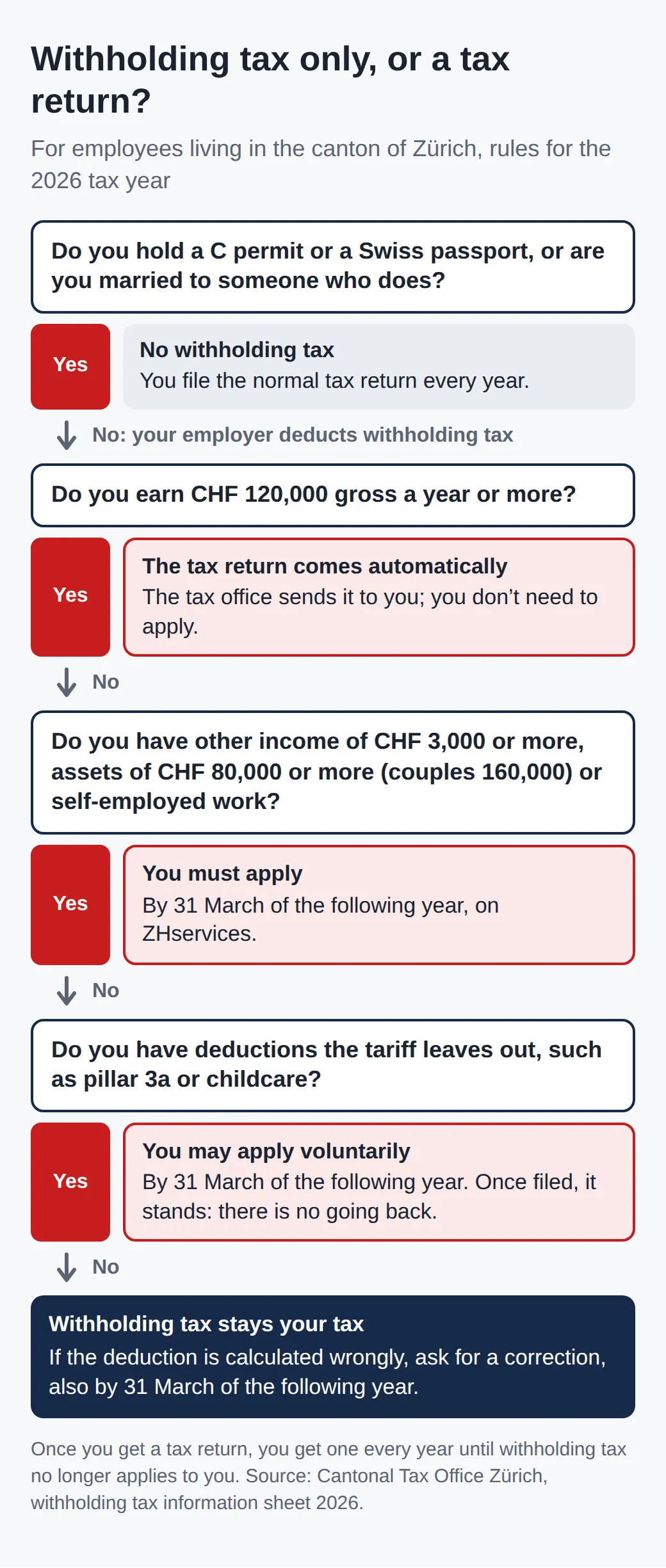
If you earn at least CHF 120,000 gross a year, you're assessed automatically. If you move here from abroad during the year, the tax office scales your salary up to twelve months, but not bonuses or other one-off payments. For married couples the salaries aren't added together. But if one of you reaches the limit, you're both assessed jointly. Worth knowing for later: from then on you get a tax return every year until withholding tax no longer applies to you, even if your salary drops below CHF 120,000 again.
Other income or assets: you must apply
If, besides your salary, you have income of at least CHF 3,000 that isn't subject to withholding tax, such as interest and dividends, or taxable assets of at least CHF 80,000 (CHF 160,000 for married couples), you must apply for the tax return yourself. Property abroad doesn't count towards either limit. The same applies if you're self-employed on the side or want to reclaim the federal anticipatory tax (Verrechnungssteuer) on interest and dividends. In these cases nobody will send you anything unprompted.
Applying voluntarily, and the rules that come with it
Everyone else may apply for an NOV without giving a reason. You can only do it online, through ZHservices. You need a user account, your personal details and your AHV number, but no receipts yet. The deadline is 31 March of the following year, so for your 2026 income it's 31 March 2027. It can't be extended. If your application is incomplete, you have ten days to complete it. If you move abroad before then, the application must be in by the day you deregister at the latest, and you need a postal address in Switzerland.
The sentence to read before you click is in the information sheet: an application filed correctly and on time can't be withdrawn. Nor does it apply to one year only. From then on you get a tax return every year until withholding tax no longer applies to you. The forms arrive some time after the application. For the 2026 tax year, the Zürich tax manual (Zürcher Steuerbuch) sets the deadline at 31 March 2027. If you only get the forms after the end of February 2027, you have 30 days.
If you live abroad, you can apply for an NOV too, but only if one of these conditions is met: at least 90% of the family's worldwide income is taxed in Switzerland, your situation is comparable to that of someone living in Switzerland, or a double taxation agreement requires Switzerland to grant certain deductions. This application has to be made again every year.
Is it worth applying?
It pays off if your real deductions are well above the standard amounts in the tariff. There's no reliable formula, because a tax return looks at everything together. But you can estimate the direction quite well. These point towards applying:
- You pay into pillar 3a regularly or make buy-ins to your pension fund.
- You pay for a daycare centre, a childminder or after-school care.
- You pay for your own further training, or pay maintenance or interest on debts.
- Your commute costs much more than CHF 1,400 a year.
- You live in a municipality with a low tax multiplier.
- A bonus or the 13th salary made a single month much more expensive.
The case against is when hardly any of this applies and you live in a municipality with a high tax multiplier. Then the tax return can cost more than the withholding tax, and there's no way back. So do the sums first. The canton's tax calculator works out the ordinary tax for your municipality. Put the result next to the withholding tax on your salary certificate. If the difference is small, the yearly effort is hardly worth it. If it's large, it will probably repeat in the years that follow.
Not every reason to doubt your withholding tax calls for a tax return. Sometimes the deduction is simply wrong.
A correction instead of an NOV: when the deduction is wrong
If your withholding tax has been calculated wrongly, apply for a withholding tax correction, also online and by 31 March of the following year. The grounds are listed exhaustively: you dispute that you're liable at all, the taxable salary or the salary used to set the rate is wrong, your employer applied the wrong tariff, or working days abroad need to be taken out. You can't claim deductions with a correction; that's what the NOV is for.
What prompts it is usually on your salary certificate (Lohnausweis). The withholding tax deducted is in box 12, and the canton recommends checking it as soon as you get the certificate after the end of the year. Does the tariff still match your situation? Many errors happen because a change was never reported. Among other things, you must tell your employer about a marriage, a separation, the birth of a child, a second job, a job change by your partner and leaving the church yourself. The new tariff applies from the following month.
Since 1 January 2026 one door has closed: according to the information sheet, the tax office no longer accepts requests for revision because of international double taxation. If your salary is taxed in two countries after the deadline has passed, the only route left is a mutual agreement procedure, which, as someone living in Switzerland, you request from the State Secretariat for International Finance (SIF) in Bern. Conversely, the tax office can claim back withholding tax that was under-deducted, going back up to five years, if your employer made mistakes. And if you live in Switzerland and maintenance payments push you below the subsistence minimum, you can ask the Cantonal Tax Office for extra child deductions in the tariff: in writing, not by email, also by the end of March.
What to do by the end of March
31 March is the date to remember, for corrections and the NOV alike, and it can't be moved. For the 2026 tax year, go about it like this: check your salary certificate as soon as it arrives and compare box 12 with your payslips. Collect the receipts for everything the tariff doesn't know about, from your pillar 3a statement to the daycare bill. Use the tax calculator to work out what a tax return would cost in your municipality. And only apply on ZHservices once the result is clearly in your favour.
If you're looking for a new job in Zürich, you can factor in the deduction as soon as you get an offer: work out your tariff, look up the rate for the monthly salary and keep the month with the 13th salary in mind. You'll find open positions with us under full-time or part-time, for example. For questions about your own case, the Cantonal Tax Office's withholding tax department can help by email or phone.
Common questions
- How much withholding tax do cross-border commuters from Germany pay in Zürich?
- If you live in Germany and return home every day, Zürich takes a flat 4.5% of your gross salary. Your employer still shows a tariff code on your payslip: L is the equivalent of A, M of B, N of C, P of H and Q of G.
- How does withholding tax work if I have two jobs in Switzerland?
- Each employer deducts withholding tax itself, but the rate depends on your total income or your total workload. Failing that, the employer scales your salary up to a full-time job. So tell both employers about the second job, or the rate will be wrong.
- Do I have to pay church tax in Zürich?
- Only if you belong to the Swiss Reformed, Roman Catholic or Christian Catholic church. Then your tariff code ends in Y, otherwise in N. If you leave the church, tell your employer: the new tariff applies from the following month.
- Can I get the withholding tax on my pension back when I leave Switzerland?
- Possibly. When you live abroad and take a lump sum from your pension fund or pillar 3a, the institution deducts withholding tax. If the double taxation agreement with your new country allows it, you can claim a refund from the Cantonal Tax Office within three years of the payout.
- How do I prove to an authority how much withholding tax I have paid?
- You can ask for a certificate of the withholding tax deducted at any time, and the Cantonal Tax Office has an online request for it. For the whole year, the amount is also shown in box 12 of your salary certificate.
More posts
All posts
Minimum Wage in Zürich: CHF 23.90, Who Gets It and When
Zürich's minimum wage is CHF 23.90 an hour, Winterthur's CHF 23. What the Federal Supreme Court ruled, who gets it, the exceptions and when it starts.
Zurich Labour Court 2026: Process, Deadlines and Costs
A dispute over pay, a reference or dismissal? How to get from the justice of the peace to Zurich's labour court, which deadlines apply and what it costs.

Daycare Costs in Zurich 2026: Fees, Subsidies, Tax Deduction
Subsidised daycare (Kita) in Zurich costs CHF 12 to 120 a day in 2026. How the city sets your fee, what you can deduct and what an extra workday costs.