Zürich Commuting Tax Deduction 2026: Travelcard, Bike, Car
At a glance
In the canton of Zürich, you can deduct up to CHF 5,200 for your commute from your cantonal and municipal taxes in 2026, and up to CHF 3,300 from the direct federal tax. If you go by train, tram or bus, your travelcard counts; by bike, a flat CHF 700. Your car only counts in four exceptional cases, and then at CHF 0.75 per kilometre.
The rules are set by the canton's Department of Finance and the Federal Tax Administration (FTA), the prices by the Zürich Transport Network (ZVV) and Alliance SwissPass. None of these sources answers the question that matters most when you fill in the form: what is the deduction worth in francs? We worked it out for five typical commutes. With a taxable income of CHF 70,000, you get back roughly a fifth of what you deduct. Most of the official sources are in German; where there's an English version, we link that.
What you can deduct in 2026
Zürich's rules are set out in a directive from the Department of Finance that applies from the 2026 tax year. For federal tax, the FTA sets them every year in a circular. The basic idea is the same in both: you can deduct what getting to work costs you. If you drive, though, you usually only get as much as a travelcard for the same route would cost.
| Commute | Canton of Zürich | Federal |
|---|---|---|
| Train, tram, bus, boat | the necessary cost of your travelcard | the necessary cost of your travelcard |
| Bike, e-bike with a yellow plate | CHF 700 flat rate | CHF 700 flat rate |
| Car, only in exceptional cases | CHF 0.75 per km | CHF 0.75 per km |
| Maximum per year | CHF 5,200 | CHF 3,300 |
If you're still filling in your 2025 tax return, the same maximums apply. Only the rate for the car was lower, at CHF 0.70 per kilometre, as the 2025 professional expenses form shows. The federal government last raised its maximum for 2025, from CHF 3,200 to CHF 3,300, to offset inflation. It stayed the same for 2026.
The difference between cantonal and federal tax matters. You fill in a single form, but it has two columns. In the cantonal column you enter up to CHF 5,200, in the federal one up to CHF 3,300. If you spend less, you won't notice. If you spend more, say on a GA travelcard or a car, you can deduct less for federal tax than for cantonal tax. So what your travelcard costs decides whether you hit a limit at all.
What a ZVV travelcard costs in 2026
Until the timetable change on 13 December 2026, a personal ZVV annual travelcard for 2nd class costs between CHF 474 for the local network of a single municipality and CHF 2,308 for all zones, according to the ZVV's NetworkPass price list. For 1–2 zones it's CHF 813. So even the most expensive 2nd-class annual travelcard stays below both maximums. If you commute within the ZVV network, you deduct your travelcard in full.
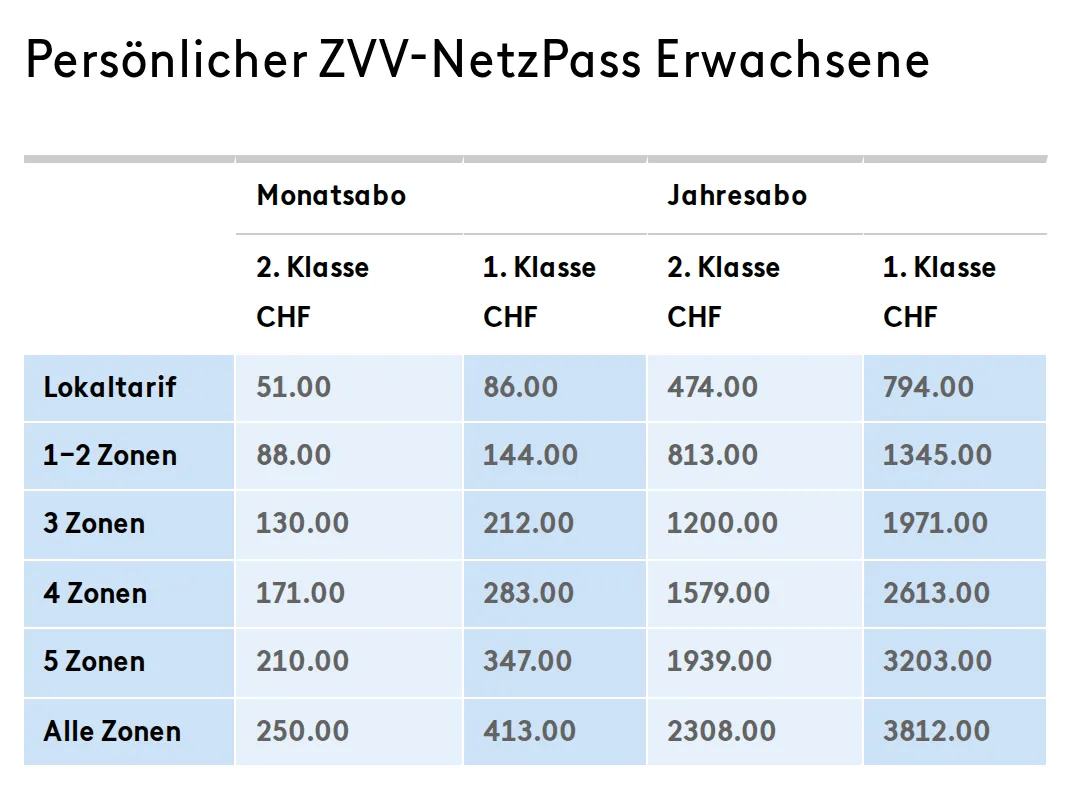
One rule affects everyone travelling in either of the two cities: Zürich is zone 110, Winterthur zone 120, and for both the ZVV says you need at least a travelcard for 1–2 zones. The cheaper local network fare, which otherwise covers a single municipality, doesn't exist in the two cities. The ZVV zone map shows exactly which zones your commute needs.
Prices go up after the timetable change. On 24 September 2026, the cantonal government approved a fare increase of 2.7 percent on average. Travelcards and single tickets rise by 2.1 percent on average, and the discounts on multi-trip tickets disappear entirely. In the canton's fare examples, the annual travelcard for 1–2 zones goes up from CHF 813 to CHF 840, the one for all zones from CHF 2,308 to CHF 2,363. The monthly travelcard for 1–2 zones rises from CHF 88 to CHF 91, and even the local network monthly pass from CHF 51 to CHF 52. The short-distance ticket is one of the fares that stay the same.
For tax purposes, what counts is the price you actually paid, so it's worth keeping the receipt or the statement from your SwissPass account. Many people in the city still have one question, though: what happened to the CHF 365 travelcard?
The CHF 365 travelcard comes in 2028 at the earliest
On 28 September 2025, voters in the city of Zürich approved a popular initiative for an annual travelcard costing CHF 365 in zone 110. In September 2026, the City Council adopted its implementation proposal. It doesn't create a new travelcard. Instead, everyone whose main residence is in the city gets a discount by voucher code on existing personal annual travelcards for zone 110 and on the GA travelcard. The City Council expects this to cost around CHF 140 million a year and is asking for CHF 195 million. The City Parliament decides first, and then another popular vote is needed. If voters say yes, the discount will arrive in spring 2028 at the earliest.
For your taxes, only the price you pay yourself after the discount is then likely to count. And if you commute beyond the ZVV area, you'll soon end up with a GA travelcard anyway.
GA travelcard: not fully deductible for federal tax
An adult GA travelcard costs CHF 3,995 in 2nd class and CHF 6,520 in 1st class until the timetable change, according to SBB. From 13 December 2026, Alliance SwissPass says the prices rise to CHF 4,095 and CHF 6,770.
This is where the federal cap bites. If you live in the canton of Zürich and use a GA to travel to work in Bern, Lucerne or St. Gallen every day, you can deduct the full CHF 3,995 for cantonal tax, but only CHF 3,300 for federal tax. Watch one word in the directive: what you can deduct is the "necessary" cost of a travelcard. If a point-to-point travelcard for your route would be much cheaper, the tax office can count only its price. If in doubt, make a note of what a point-to-point travelcard for your route would cost. The rules for cars are stricter still.
Can I deduct my car?
Only in exceptional cases. If you drive your own car to work, you can generally deduct only as much as a travelcard for the same route would cost. The directive from the Department of Finance allows the cost of the car itself in just four cases.
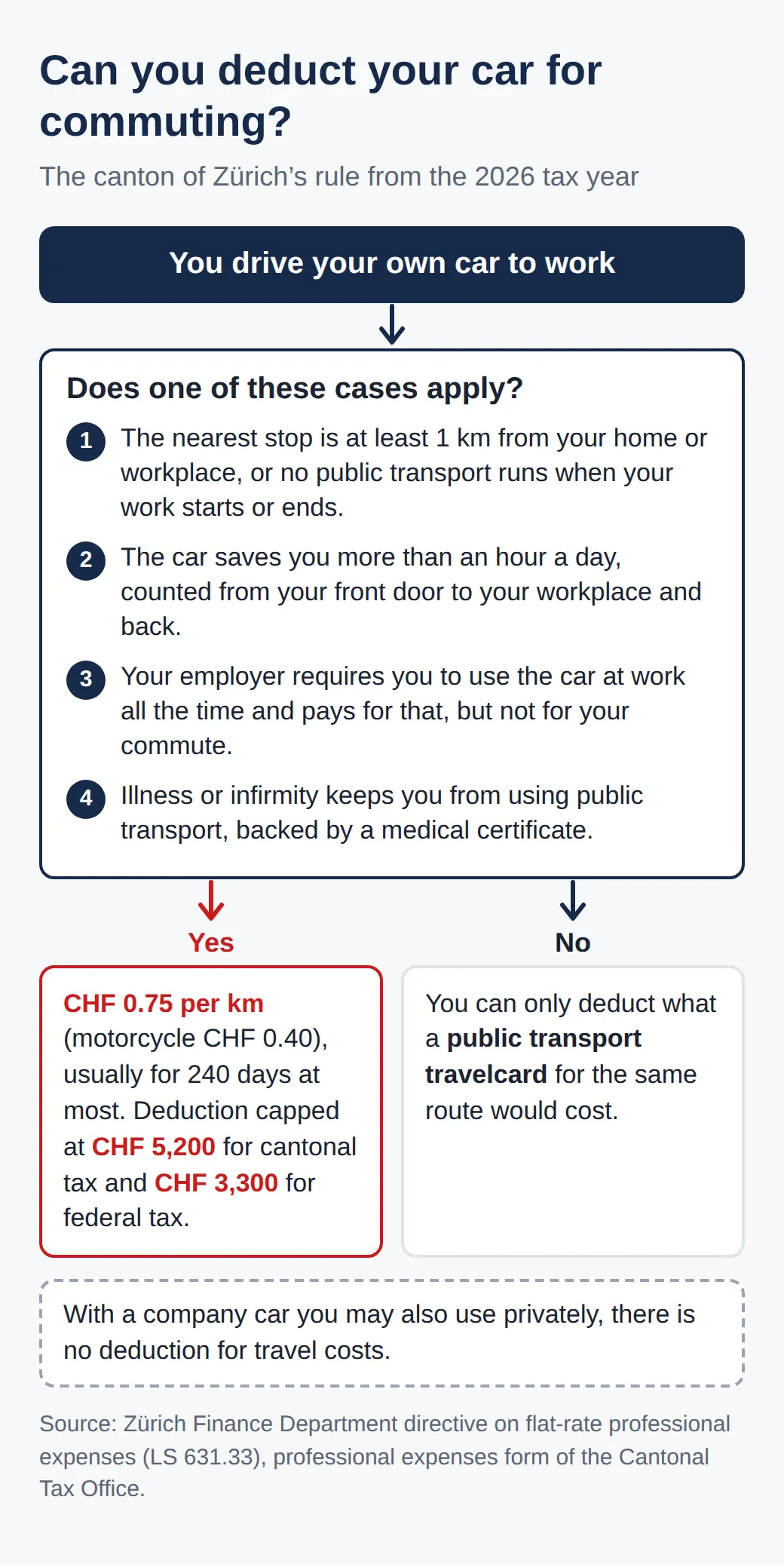
In the first case, there's no public transport. That applies if the nearest stop is at least one kilometre from your home or your workplace, or if nothing runs when your work starts or ends. If you work shifts, say in a hospital or in logistics, and start or finish in the middle of the night, you may meet this condition. The second case is a time saving of more than an hour, measured from your front door to your workplace and back. That's one hour per day, not per trip. The third case covers employees whose employer requires them to use their own car constantly during work and pays them for it, but not for the commute. The fourth case is illness or infirmity, backed by a medical certificate.
If one of the cases applies, tick it on the form under item 7 and use a rate of CHF 0.75 per kilometre, or CHF 0.40 for a motorcycle with a white plate. The formula is working days times kilometres times trips per day. The form gives 240 working days as the usual maximum. An example: 25 kilometres each way, twice a day, on 220 days makes 11,000 kilometres and CHF 8,250. Of that, you can deduct CHF 5,200 for cantonal tax and CHF 3,300 for federal tax. If you drive home for lunch, those trips are deductible only up to CHF 3,200 a year, and in return you lose the deduction for meals away from home.
With a company car, there's no deduction at all. If you also use a company vehicle privately and pay tax on a private-use share, the form says you can't deduct any travel costs. For cyclists, by contrast, things are much simpler.
Bike and e-bike: CHF 700 without receipts
If you always cycle to work, you deduct a flat CHF 700 a year, for cantonal and federal tax alike. You don't need any receipts for it. In Zürich, the same flat rate applies to mopeds and motorcycles with a yellow plate, which includes fast e-bikes that carry one.
The directive requires that you use the bike consistently. If you only ride in summer and switch to a travelcard in winter, the directive has no rule for that mix. In that case, enclose the travelcard receipts and ask your municipal tax office how it counts the months you cycled. How much all these deductions are worth on your tax bill in the end is the real question.
How much tax you save
A deduction of CHF 1,000 doesn't save you CHF 1,000, only the tax on that amount. How much that is depends on your income and your municipality. We worked out one example in detail: a single person without church tax, with a taxable income of CHF 70,000, living in a municipality with a tax multiplier (Steuerfuss) of 112 percent, such as Embrach or Niederhasli.
In this income range, the basic cantonal tax is 8 percent on every extra franc. The canton and the municipality each multiply it by their tax multiplier: for 2026, 95 percent for the canton, according to the Statistical Office, and 112 percent for the municipality. That comes to 16.56 centimes per franc deducted. The 2026 federal tax scale adds just under 3 centimes. Together, you save around 20 centimes per franc.
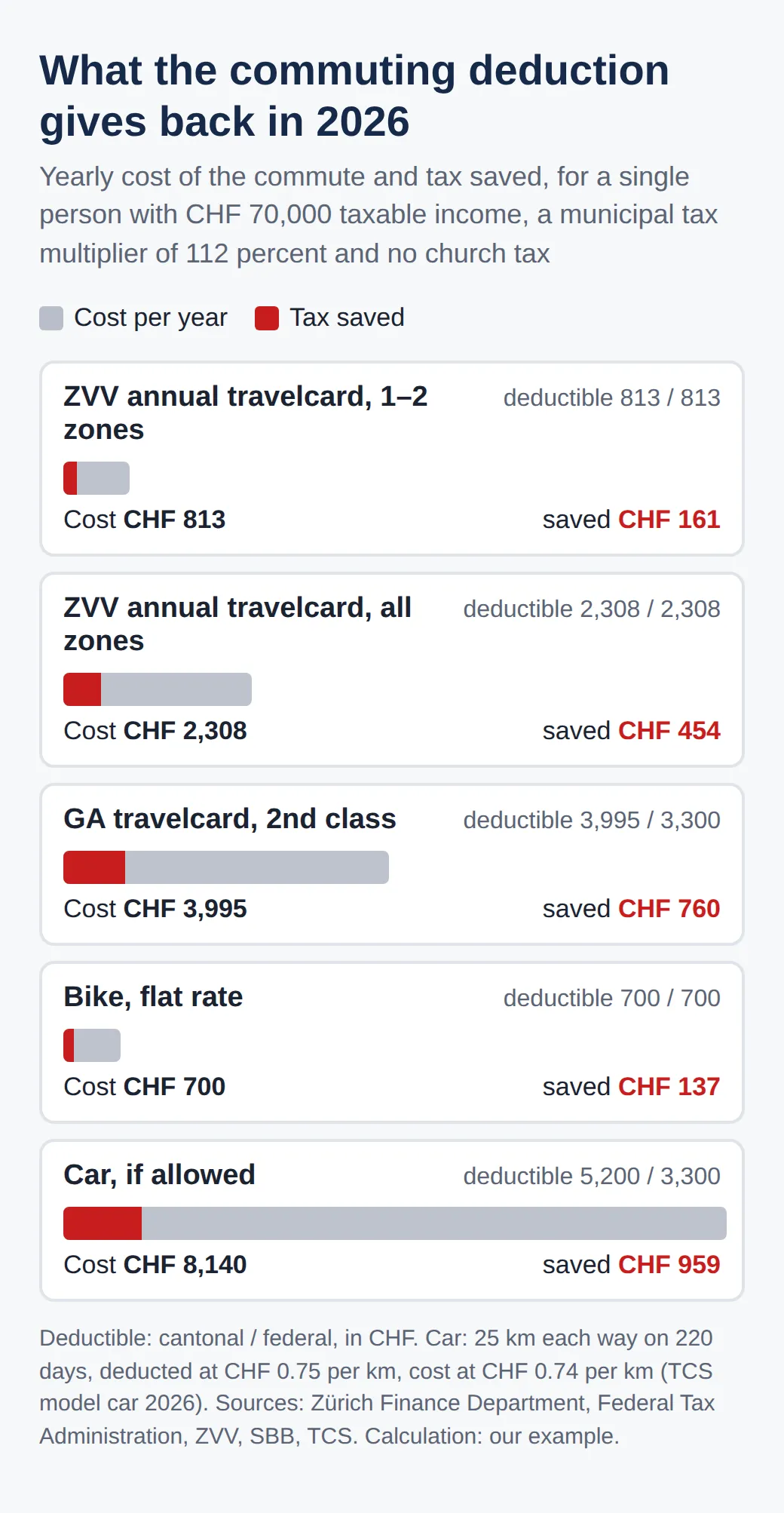
If you buy an annual travelcard for the city for CHF 813, you get CHF 161 back through your taxes. With a travelcard for all zones it's CHF 454, with a GA CHF 760. With the GA, the federal cap costs you little, because federal tax takes little per franc anyway: the CHF 695 you can't deduct there would save only about CHF 21 in federal tax at this income.
The gap is widest with the car. Touring Club Switzerland (TCS) puts the cost of its 2026 reference car, a new car costing CHF 45,000 and driven 15,000 kilometres a year, at around 74 centimes per kilometre. At the same rate, the 11,000 kilometres in our example cost a little over CHF 8,100. Even if the tax office accepts the car, only CHF 959 of that comes back through your taxes, because the caps cut the deduction.
If you earn more, each franc you deduct is worth more, because higher slices of income are taxed more heavily. In the city of Zürich, with its tax multiplier of 119 percent, it's also a little higher. Our post on salaries in Zürich shows where your pay stands. But the arithmetic stays the same in every case: the deduction makes commuting cheaper, not cheap. It looks quite different when your employer pays part of it.
When your employer pays for your travelcard
You can't deduct what your employer pays. The directive from the Department of Finance says so explicitly: where your employer reimburses professional expenses, you're not entitled to a deduction. If your company pays for the whole travelcard, the deduction is gone. If it pays part, you deduct only your own share.
Your salary certificate (Lohnausweis) has its own box for this, field F, «Unentgeltliche Beförderung zwischen Wohn- und Arbeitsort», meaning free transport between home and work. If it's ticked, your employer covered your commute. So check your salary certificate before you fill in the form, and if you got a contribution, enter only the amount you paid yourself.
A common model is the ZVV's BonusPass, a corporate travelcard: the company pays part of the cost, and its employees get a discounted personal annual travelcard for all zones. If you're starting at a large employer, ask about contributions like this at the interview; our post on the largest employers shows which companies employ the most people in Zürich. One group of employees, on the other hand, doesn't fill in this form at all.
With withholding tax, the deduction is already built in
If you pay withholding tax (Quellensteuer) in the canton of Zürich, you get part of the commuting deduction automatically. The 2026 rates assume travel costs of CHF 1,400 for cantonal tax and CHF 800 for federal tax. That more or less covers an annual travelcard for 1–2 zones, but not one for all zones or a GA.
If your travel costs are much higher, the only way to claim the rest is a subsequent ordinary assessment, in other words a normal tax return. Our post on withholding tax in Zürich explains whether that's worth it for you and which deadlines apply. For everyone else, the question is what makes the difference day to day.
Part-time, working from home and commuting to Zürich
If you go into the office on fewer days, you pay less and deduct less. With a car you see this directly, because the form asks for the number of working days. With public transport, it pays to do the sums before you buy: an annual travelcard for all zones costs CHF 2,308 until mid-December, while twelve monthly ones cost CHF 3,000. If you only commute two or three days a week, single tickets or multi-trip tickets may work out cheaper. From 13 December 2026, though, the discounts on multi-trip tickets go, and the travelcard becomes more attractive again by comparison.
Commuting is the norm in Switzerland. According to the Federal Statistical Office, 3.7 million employed people in Switzerland were commuters in 2024, eight in ten. On average they travelled 14 kilometres each way, taking 30 minutes. Just under half went by car, 31 percent by public transport and 18 percent on foot or by bike. The time you spend travelling doesn't appear on any tax form. It still belongs in any comparison of two jobs: an hour a day adds up to 220 hours a year over 220 working days.
How to fill in the form
Travel costs go on the professional expenses form (Berufsauslagen) that you enclose with your tax return, and from there onto page 3 under item 11. The guide to the tax return (Wegleitung) explains every line. Essentially, three of them matter:
- Item 1.1 for your public transport travelcard, with the amount you paid yourself
- Item 1.2 for a bike, e-bike or moped, a flat CHF 700
- Item 1.3 for a car or motorcycle, with your place of work, working days and kilometres, plus your reason under item 7
In the cantonal column, enter no more than CHF 5,200, and in the federal one no more than CHF 3,300. Keep the receipts for your travelcard. If you drive, note which of the four cases applies and how you can prove it, for example with the timetable for your working hours. According to the guide, two cases need a supporting document: if you need the car because your employer requires it, add your employer's confirmation; if you're ill, the medical certificate.
And if you're looking for a new job: work out the commute before you say yes. A GA costs over CHF 3,000 a year more than a travelcard for 1–2 zones, and in our example the commuting deduction gives back only about a fifth of that. A workplace close to home, or an employer who contributes to your travelcard, is often worth more than a few hundred francs extra in salary.
Common questions
- Can I claim the Zürich commuting deduction if I live in another canton?
- No. You pay income tax in the canton where you live, and that canton's rules on travel costs apply. If you live in Aargau or Thurgau and work in Zürich, you fill in your home canton's tax return. The federal tax, with its maximum of CHF 3,300, is the same everywhere.
- How does working from home affect the commuting deduction?
- For a car, only the days you actually drive to work count. The form asks for the number of working days and gives 240 days as the usual maximum. For public transport, the necessary cost of your travelcard counts, meaning what you actually paid for your commute.
- Can both spouses claim the full commuting deduction?
- Yes. If you both work, the tax office calculates professional expenses for each person separately. The form has two sides for this, and the maximum of CHF 5,200 for cantonal tax and CHF 3,300 for federal tax applies to each of you.
- What can weekly residents deduct for travel to work?
- If you live at your place of work during the week, you can deduct the weekly trip home, usually the cost of public transport such as a GA travelcard. For cantonal tax, these trips count towards the same maximum of CHF 5,200. On top of that, there are separate deductions for your room and your evening meals.
More posts
All posts
Daycare Costs in Zurich 2026: Fees, Subsidies, Tax Deduction
Subsidised daycare (Kita) in Zurich costs CHF 12 to 120 a day in 2026. How the city sets your fee, what you can deduct and what an extra workday costs.
Average Salary in Zürich? The Median by Industry, 2024
Median salary in Zürich in 2024: CHF 8,508 a month in the city, CHF 7,502 in the canton. By industry, age and gender, with gross and net explained.

Minimum Wage in Zürich: CHF 23.90, Who Gets It and When
Zürich's minimum wage is CHF 23.90 an hour, Winterthur's CHF 23. What the Federal Supreme Court ruled, who gets it, the exceptions and when it starts.